Understand program differences
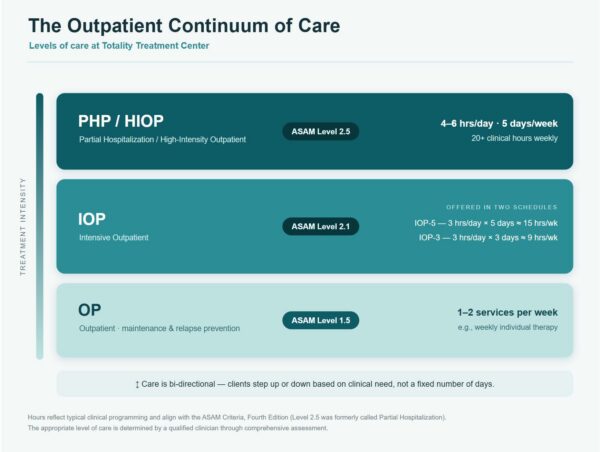
When you’re exploring levels of care for mental health or addiction treatment, it helps to know how outpatient therapy, an intensive outpatient program (IOP), and a partial hospitalization program differ. Each offers varying degrees of structure, clinical oversight, and flexibility. By comparing these options, you can decide which environment aligns best with your recovery goals and daily responsibilities.
| Program type | Hours per week | Supervision level | Ideal for |
|---|---|---|---|
| Outpatient therapy | 1–2 hours | Low – weekly individual or group sessions | Early recovery, minimal support needs |
| Intensive outpatient program (IOP) | 9–20 hours | Medium – multiple days of group and individual therapy | Stable home life, need for peer support |
| Partial hospitalization program | 20+ hours | High – daily therapy, medical and nursing oversight | Complex or co-occurring conditions, high relapse risk |
Outpatient therapy
Outpatient counseling involves regular individual or group sessions, typically one or two times per week. You’ll meet licensed therapists who guide coping strategies, behavioral changes, and support relapse prevention. This level of care is most suitable if you have steady support at home and can manage responsibilities like work or school with minimal disruption. If you later decide you need more structure, you might explore an intensive outpatient program near me or consider transitioning to an outpatient therapy that addresses both mental health and addiction.
Intensive outpatient program (IOP)
An IOP bridges outpatient therapy and PHP by offering 9 to 20 hours of weekly care. Sessions often run three to five days each week, combining group therapy, individual counseling, educational workshops, and skill-building activities. You’ll benefit from peer support while retaining enough flexibility to continue fulfilling daily obligations. For specialized formats, check out our guide to iop for mental health and substance abuse.
Partial hospitalization program
A PHP delivers the most intensive outpatient treatment short of full hospitalization. You’ll participate in therapy, psychiatric evaluation, medication management, support groups, and educational classes for multiple hours each day, usually five days per week. Unlike inpatient care, you return home overnight and maintain community ties. This format can ease the step-down from inpatient services or serve as a standalone option when you require consistent oversight without full hospitalization (Transitions Counseling and Consultation). Partial hospitalization programs are the most intensive form of outpatient treatment, combining medical supervision and structured activities to support lasting recovery (Harmony Recovery Group).
Assess insurance coverage
Before you select a partial hospitalization program, it’s essential to understand how United Healthcare (UHC) covers PHP services. Coverage varies by plan type, medical necessity criteria, provider network status, and prior authorization requirements. Reviewing these factors can prevent unexpected out-of-pocket costs.
Coverage policies under UHC
United Healthcare generally includes PHP benefits under most plans, covering:
- Outpatient group and individual therapy
- Psychiatric evaluation and medication management
- Educational workshops and skills training
- Family therapy sessions, when deemed medically necessary
Coverage specifics such as copays, coinsurance, and session limits depend on your policy. For emerging adults, UHC often covers young adult PHP services at providers like BreakThrough by BasePoint, subject to plan requirements (BasePoint BreakThrough). Federal law under the Mental Health Parity and Addiction Equity Act ensures UHC cannot impose stricter criteria on behavioral health benefits than on medical benefits (Thrive Mental Health).
Prior authorization process
Most UHC plans require prior authorization before a PHP begins. Typical steps include:
- Your provider submits a treatment plan outlining goals, duration, and services
- UHC reviews medical necessity based on diagnosis and care history
- You receive approval or a request for additional information
Start authorization early to avoid delays in your care plan.
In-network vs out-of-network
Choosing an in-network provider reduces your financial burden because UHC negotiates contracted rates. If you select an out-of-network facility, you may face higher coinsurance or uncovered services. Always verify network status through your UHC online portal or customer service.
Choose in-network providers
Finding a facility that accepts UHC and offers a PHP requires research. You want a center with accreditation, experienced staff, and treatment modalities suited to your needs.
Search provider directory
Begin by using the UHC provider search tool or calling the number on your insurance card. Filter results for “partial hospitalization program” and confirm each center’s participation in your network.
Verify credentials and specializations
Look for programs that treat co-occurring conditions, use evidence-based therapies, and offer relapse prevention support. If dual diagnosis care is essential, consider a php program for co-occurring disorders. For assistance in selecting high-quality options, explore our recommendations for the best php program for addiction recovery.
Prepare for admission
Once you’ve shortlisted in-network PHP providers, take these steps to streamline the intake process and ensure your benefits apply smoothly.
Intake assessment steps
Your potential PHP will schedule an evaluation that typically includes:
- Clinical interview covering mental health history and substance use
- Physical exam or medical clearance
- Psychological assessments or questionnaires
- Verification of UHC coverage and benefits
This assessment helps the team develop a personalized treatment plan aligned with your goals.
Pre-admission requirements
Prepare documentation such as:
- UHC insurance card and policy details
- Referral or authorization form from your primary care physician or psychiatrist
- Identification and completed intake forms
Completing paperwork in advance speeds up your admission and secures your spot.
Confirm program readiness
Entering a PHP is a significant commitment. Evaluate your personal circumstances and support network to maximize your chances for success.
Evaluate personal stability
Ask yourself:
- Do I have a safe, stable home environment?
- Can I arrange transportation to the facility each day?
- Am I prepared to commit several hours daily to therapy and activities?
A clear assessment ensures you can follow through on treatment recommendations.
Establish support system
Involve family, close friends, or peer support groups so you have encouragement outside the program. If you anticipate challenges related to relapse triggers, look into a php program with relapse prevention support.
Take next steps
With clarity on program differences, UHC coverage, provider selection, and admission readiness, it’s time to move forward.
Contact treatment centers
Reach out to your top in-network PHP providers. Discuss your treatment goals, verify coverage details, and ask about scheduling an initial tour or consultation.
Plan your care journey
Once you’ve secured authorization and admission dates, outline your daily schedule, transportation plans, and aftercare resources. Establishing this roadmap helps you focus on healing without logistical distractions.
Your path to lasting recovery begins with informed decisions. By choosing a partial hospitalization program that accepts UHC, you’re accessing an intensive, structured level of care supported by your insurance. Take action today by connecting with an in-network provider and stepping into a supportive environment designed to guide you toward improved well-being.