Outpatient treatment allows you to receive structured, professional support for mental health concerns, substance use challenges, or co-occurring conditions while continuing to live at home and move through your daily life. Rather than stepping away from everything to enter a residential facility, you attend scheduled therapy sessions, group work, and clinical programming during set hours — then return to your family, your job, your responsibilities, and the life you are actively learning to navigate differently.
The benefits are meaningful and practical: flexible scheduling that works around real obligations, the ability to practice new coping skills in your own environment the same day you learn them, consistent connection to the people and community who matter to you, and personalized clinical care that adapts as your needs shift. For many adults, outpatient care is not a lesser option — it is the option that makes sustained engagement with treatment genuinely possible.
This article explains what outpatient treatment involves, walks through the specific benefits worth understanding, breaks down the different levels of outpatient care so you can see where you might fit, and offers honest guidance about when outpatient treatment may — or may not — be the right starting point. If you are weighing your options or helping a loved one do the same, this is designed to help you think it through clearly.
What Is Outpatient Treatment?
Outpatient treatment is a form of clinical care where you attend scheduled sessions at a treatment center during the day, evening, or through telehealth — and return home afterward. You are not living at the facility. You are receiving professional therapeutic support while maintaining as much of your normal routine as your current health allows.
This stands in contrast to residential or inpatient treatment, where you live on-site full-time, typically for 30 days or longer. Both paths serve important purposes, and they are not in competition with each other. Many people move through more than one level of care during their recovery journey — starting with residential treatment when they need the most structure, then stepping down into outpatient care as they stabilize. Others begin directly with outpatient programming when their clinical needs, living situation, and support system make it appropriate.
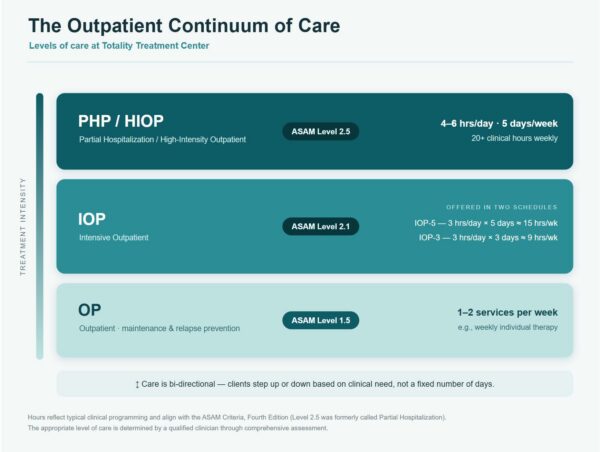
What many people do not realize is that outpatient treatment is not a single thing. It spans a range of intensity levels — from a few hours of therapy per week to near-full-day programming five or more days a week. The right level depends on where you are clinically, what your daily life requires, and what a clinical assessment determines is safe and appropriate.
At Totality Treatment Center, outpatient care includes several distinct program tracks — Partial Hospitalization (PHP), Intensive Outpatient (IOP), an Individualized Intensive Program (IIP), a Night Track designed for people who need evening hours, telehealth options, and traditional in-person outpatient sessions. Each one is built to meet a different set of needs while keeping you connected to your life outside the treatment setting.
Key Benefits of Choosing Outpatient Treatment
The advantages of outpatient care go beyond convenience. They touch the core of what makes treatment sustainable — the ability to stay engaged long enough for real change to take root, without losing the parts of your life that give that change meaning.
Flexibility to Maintain Your Daily Life
One of the most immediate benefits of outpatient treatment is that it is designed to work around the life you already have. If you are a working professional who cannot take an extended leave, a parent whose children depend on you being home each evening, or a student trying to stay enrolled, outpatient programming can be scheduled so that treatment supports your responsibilities rather than replacing them.
This matters more than it might seem on the surface. When people feel forced to choose between getting help and keeping their life together, many delay treatment — sometimes for months or years. Outpatient care removes that choice by making both possible at the same time. At Totality Treatment Center, this flexibility is built into the program structure itself. The Night Track, for example, is specifically designed for adults who work during the day or have daytime caregiving obligations but still need the clinical intensity of a structured program. Telehealth sessions extend that flexibility further, allowing participation from home when in-person attendance is not feasible on a given day.
Practicing Recovery Skills in Your Own Environment
There is a therapeutic benefit to outpatient care that is easy to overlook: you are learning and applying skills in the same environment where you actually need them. When you attend a group therapy session in the morning and then face a stressful situation at work that afternoon, you have a real-time opportunity to use what you just learned — and then bring the results back to your next session for reflection.
In a residential setting, the environment is intentionally controlled. That safety is valuable when someone needs it. But for people who are ready for it, the daily practice of navigating real triggers, real relationships, and real decisions while receiving clinical support can build a kind of confidence and self-awareness that transfers directly into long-term wellness. You are not preparing to eventually handle real life. You are doing it now, with professional guidance alongside you.
Staying Connected to Family and Community
Recovery does not happen in isolation, and neither does mental health treatment. One of the distinct advantages of outpatient care is that you remain embedded in the relationships and community ties that will continue to matter long after formal treatment ends.
Family members can be involved in the treatment process more naturally — attending family sessions, learning about what their loved one is working through, and adjusting their own patterns of support in real time. Friends, mentors, faith communities, recovery peers, and other existing support systems remain accessible rather than paused. This continuity is not just emotionally comforting — it can be therapeutically meaningful, giving your treatment team insight into how your relationships actually function and where support may need to be strengthened.
At Totality Treatment Center, community is central to the care model. Group therapy, peer connection, and a structured supportive environment are built into every program level. The goal is not just to provide clinical services but to help you feel less alone in the process — to replace the exhaustion of managing everything by yourself with a team and a community that share the work with you.
Personalized Treatment That Adapts Over Time
Outpatient treatment is not a fixed path. A well-designed outpatient program adjusts as you progress, as your symptoms shift, and as your life circumstances change. Your treatment plan may start with more intensive programming and step down over time, or it may shift focus from one concern to another as clinical needs become clearer.
This is especially important for people managing dual diagnosis — the combination of a mental health condition and a substance use concern. Treating both effectively requires an integrated, individualized approach, not a one-size-fits-all protocol. At Totality Treatment Center, dual diagnosis treatment is woven into the clinical framework rather than treated as an add-on. Individual therapy, group sessions, and case management are coordinated around each person’s full clinical picture, and adjustments happen as that picture evolves.
Privacy and Discretion
For many adults, the idea of stepping away from their life for an extended period raises concerns that go beyond logistics. There may be professional consequences, social stigma, or simply a personal preference to keep treatment private. Outpatient care allows you to receive meaningful clinical support without an extended, visible absence from your daily world.
Evening programming, telehealth participation, and flexible scheduling can make it possible to attend treatment without most people in your life needing to know unless you choose to tell them. This is not about hiding — it is about having the ability to manage your own narrative while you focus on getting well. Totality Treatment Center’s Night Track and telehealth options are designed with this kind of discretion in mind, giving you clinical structure without requiring you to explain a weeks-long absence to an employer, extended family, or social circle.
Building Independence and Self-Management Skills
Outpatient treatment asks more of you than residential care does in certain ways — and that can be a genuine advantage for people who are ready for it. You are actively managing your schedule, making decisions about how to spend your time between sessions, and practicing accountability in real time.
This is not about being left alone to figure things out. It is about developing the muscle of self-management while a clinical team is still within reach. Over time, the daily rhythm of attending sessions, applying what you learn, and returning to discuss what worked and what did not builds a pattern of engagement that can carry forward well beyond the formal treatment period.
More Accessible Than Residential Care
Outpatient treatment is generally more accessible from a financial and insurance standpoint than residential or inpatient programs. Many private insurance plans — particularly PPO plans — may cover outpatient services, and the overall commitment is often easier to authorize and sustain. While specific coverage varies by plan and provider, outpatient care tends to present fewer financial barriers to entry, which can mean getting into treatment sooner rather than waiting.
At Totality Treatment Center, the admissions team can help you understand how your insurance may apply to the program level that fits your clinical needs. If you are exploring private-pay options, the team can walk through what that looks like as well. The goal is to make the financial side of treatment as clear and manageable as possible so it does not become another reason to delay getting support.
Understanding the Levels of Outpatient Care
One of the most common sources of confusion for people exploring outpatient treatment is that the term covers several very different levels of intensity. Understanding the differences can help you have a more informed conversation with an admissions or clinical team about what might fit your situation.
| Program Level | Typical Time Commitment | Who It May Be Appropriate For |
|---|---|---|
| Partial Hospitalization Program (PHP) | Approximately 5–6 hours per day, 5–7 days per week | Adults who need a high level of clinical structure but do not require 24-hour supervision. Often a step down from residential or inpatient care. |
| Intensive Outpatient Program (IOP) | Approximately 3–4 hours per day, 3–5 days per week | Adults who need consistent therapeutic support but can manage daily responsibilities between sessions. May follow PHP as symptoms stabilize. |
| Individualized Intensive Program (IIP) | Varies based on clinical assessment | Adults whose needs do not fit neatly into a standard PHP or IOP schedule and who benefit from a more customized treatment structure. |
| Night Track | Evening hours, schedule varies | Working adults, students, or caregivers who need clinical-intensity programming but cannot attend during traditional daytime hours. |
| Telehealth Outpatient | Varies by program level | Adults who benefit from remote participation due to schedule, transportation, health, or personal preference. |
| Standard Outpatient | 1–2 sessions per week | Adults who are further along in their recovery and need ongoing support at a lower intensity. |
At Totality Treatment Center, these levels of care are not isolated tracks — they are part of a connected continuum. A person may begin in PHP after completing detox or residential treatment, then step down to IOP as they stabilize, and eventually transition into standard outpatient sessions. The clinical team monitors progress continuously and makes recommendations about when a transition might be appropriate. The admissions team can help determine which entry point makes the most sense based on your current clinical needs and circumstances.
Who May Benefit Most from Outpatient Treatment?
Outpatient treatment is not the right fit for everyone in every situation, and part of making a good decision is understanding where it tends to work well. The following are general circumstances where outpatient care may be appropriate — though a clinical assessment is always the most reliable way to determine the right level of care.
Outpatient treatment may be a good fit if you:
- Have completed a higher level of care — such as detox, residential, or inpatient treatment — and need structured step-down support to maintain progress
- Are experiencing mental health symptoms, substance use concerns, or both, but do not require 24-hour medical supervision
- Have a stable, safe living environment to return to after sessions
- Are motivated to engage in treatment and willing to attend sessions consistently
- Need to continue working, attending school, or caring for family members while receiving care
- Have a support system — or are willing to build one — that can reinforce your recovery outside of sessions
- Want integrated care that addresses both mental health and substance use concerns in one setting
Many people who come to Totality Treatment Center are at exactly this kind of crossroads. They have completed detox or a residential stay and know they are not ready to manage on their own. Or they have been struggling with dual diagnosis challenges — mental health and substance use concerns intertwined — and recognize that piecing together their own therapists, groups, and case management is no longer sustainable. Outpatient treatment offers a structured path forward without requiring them to step away from the life they are trying to rebuild.
When Outpatient Treatment May Not Be Enough
Honesty about the limits of outpatient care is part of responsible guidance. There are situations where a higher level of care — such as residential treatment, inpatient hospitalization, or medically supervised detox — may be the safer and more appropriate starting point.
Outpatient treatment may not be the right first step if you:
- Are in acute medical or psychiatric crisis
- Need medically supervised detoxification
- Do not currently have a safe, stable living environment
- Have severe symptoms that make it difficult to function between sessions
- Have not been able to engage safely in a less structured setting in the past
If you or someone you love is in immediate danger or experiencing a medical emergency, please contact emergency services or call 988 (the Suicide and Crisis Lifeline) right away.
For situations that are not emergencies but where you are unsure about the right level of care, a conversation with a clinical admissions team can help clarify what is appropriate. Totality Treatment Center’s admissions team regularly helps people work through this question — and if outpatient care is not the right fit right now, they can offer guidance about other options and what a safe path forward might look like.
What a Typical Outpatient Experience Looks Like
One of the hardest things about considering treatment is not knowing what to expect once you walk through the door. Here is a general picture of what outpatient care tends to involve — though the specifics vary depending on your program level and individual treatment plan.
Intake and clinical assessment. Before programming begins, you meet with a clinical team member who evaluates your current needs, history, goals, and circumstances. This assessment helps determine the right level of care, the structure of your treatment plan, and any immediate priorities.
Individual therapy. Regular one-on-one sessions with a therapist who knows your story and your clinical picture. These sessions provide space to work through personal challenges, process difficult experiences, and develop strategies that are specific to your situation.
Group therapy. Structured group sessions led by a clinician, focused on topics like coping skills, relapse awareness, emotional regulation, communication, and peer support. Group work offers something individual therapy cannot — the experience of being understood by others who are navigating similar challenges.
Psychoeducation and skill-building. Sessions designed to help you understand your own mental health, substance use patterns, triggers, and the tools available to manage them. These are educational and practical, not lecture-based.
Case management. For many people in outpatient care, the logistical side of recovery — coordinating referrals, managing paperwork, connecting to outside resources, navigating insurance — can feel overwhelming. At Totality Treatment Center, case management is a hands-on part of the program. The team helps handle the coordination so that your energy can go toward the clinical work itself.
Treatment plan reviews and adjustments. Your care is not static. As you progress, your treatment plan is reviewed and adjusted. If your needs change — if you are ready to step down to a less intensive level of care, or if a new concern surfaces — the plan shifts with you.
Between sessions, you return home. You go to work, spend time with family, manage your responsibilities, and practice what you are learning. Then you come back, check in with your team, and keep building.
How Dual Diagnosis Treatment Works in an Outpatient Setting
Many adults seeking outpatient care are managing more than one concern at the same time — often a mental health condition like depression, anxiety, PTSD, or bipolar disorder alongside a substance use challenge. This is commonly called dual diagnosis or co-occurring disorders, and it is far more common than most people realize.
Treating only one condition while ignoring the other tends to leave the person cycling between partial progress and setback. Effective dual diagnosis care addresses both concerns as part of one integrated treatment plan, with therapists and clinical staff who understand how the two interact.
At Totality Treatment Center, dual diagnosis treatment is a core part of the clinical approach, not a separate track. Whether you are in PHP, IOP, the Night Track, or receiving care through telehealth, your treatment plan is designed to account for the full picture of what you are experiencing. Individual therapy, group sessions, psychiatric support, and case management are coordinated around both your mental health and substance use needs — because treating them together is how meaningful, lasting progress tends to happen.
Frequently Asked Questions
What is the difference between outpatient and inpatient treatment?
Inpatient or residential treatment means living at a facility full-time for a set period, typically 30 days or more. Outpatient treatment means attending scheduled sessions — which can range from a few hours a week to several hours a day — and returning home afterward. The right choice depends on clinical need, symptom severity, living situation, and a professional assessment. Many people move through both levels at different points in their recovery.
How long does outpatient treatment typically last?
The duration varies widely depending on the person and the program level. PHP programs may last several weeks, IOP may continue for one to three months, and ongoing outpatient therapy can extend longer depending on clinical need and progress. Treatment length is typically guided by your clinical team based on how you are responding and what your goals are.
Can I work or go to school during outpatient treatment?
Yes, in most cases. Outpatient care is specifically designed to fit around daily responsibilities. Many programs offer daytime, evening, and telehealth scheduling options. At Totality Treatment Center, the Night Track and telehealth programs are built for adults who need to maintain work, school, or caregiving schedules while participating in structured clinical care.
Can outpatient treatment help with both mental health and substance use?
Yes. Dual diagnosis treatment — which addresses mental health and substance use concerns together — is available in outpatient settings. At Totality Treatment Center, dual diagnosis care is integrated into all program levels rather than offered as a separate service, so both concerns are treated as part of one coordinated plan.
Can I receive outpatient treatment through telehealth?
Many outpatient programs now offer telehealth options, including Totality Treatment Center. Telehealth may be appropriate for certain session types and program levels, and it can be especially helpful for people managing transportation challenges, health concerns, or scheduling constraints. Your admissions team can help determine whether telehealth is a good fit for your specific situation.
How do I know if outpatient treatment is right for me?
The most reliable way to determine the right level of care is through a clinical assessment with a qualified professional. In general, outpatient treatment may be appropriate if you have a stable living environment, do not need 24-hour supervision, and are able to engage in structured programming on a regular basis. If you are unsure, calling an admissions team is a safe first step — they can help you think through your options without pressure or commitment.
Taking the Next Step
Choosing to explore treatment is not a small decision, and you do not have to make it alone. If you have been reading this article because you are trying to figure out whether outpatient care fits your situation — or the situation of someone you love — the most useful next step is a conversation with someone who can help you think it through clearly.
Totality Treatment Center’s admissions team is available to talk through your questions, help you understand which program level may be appropriate, discuss scheduling options including the Night Track and telehealth, and walk you through how insurance or private-pay arrangements may work. There is no obligation, and the conversation is confidential.
Call the admissions team at Totality Treatment Center to start the conversation. You do not need to have everything figured out before you reach out. That is what the team is here to help with.