Relapse rates without structured aftercare run as high as 40 to 60 percent in the first year of recovery, according to the National Institute on Drug Abuse. That number drops significantly when people leave treatment with a real plan in place. This guide covers everything you need to know about aftercare planning after outpatient rehab in California: what it includes, how to build one that holds, and what the research actually says about what works.
What Aftercare Planning Actually Is (and Why It Determines Your Outcome)
Aftercare planning is the structured set of supports, appointments, and commitments that begins the moment outpatient treatment ends. It is not optional follow-up care. It is the continuation of treatment itself, just in a different form. Without it, the skills and momentum built during rehab tend to erode within weeks, not months.
A 2020 review published in the Journal of Substance Abuse Treatment examined outcomes across 35 studies and found that individuals with a formal aftercare plan in place at discharge had a 50 percent lower relapse rate over 12 months compared to those who left with only informal support. The mechanism is straightforward: structure fills the space that substances once occupied, and without that structure, old patterns resurface.
Aftercare planning ideally starts on day one of treatment, not the week before discharge. When the plan develops alongside treatment, appointments are already scheduled, support contacts are already identified, and the first week after discharge is mapped in advance. That preparation is what separates a plan that holds from one that falls apart under stress.
The Types of Aftercare Support Available in California
California offers more aftercare options than most states, thanks to a combination of county behavioral health programs, telehealth infrastructure, and a large recovery community concentrated in urban areas. The statewide telehealth expansion also means these options are accessible whether you are in Los Angeles, Sacramento, or a smaller inland county.
Continuing Outpatient Services
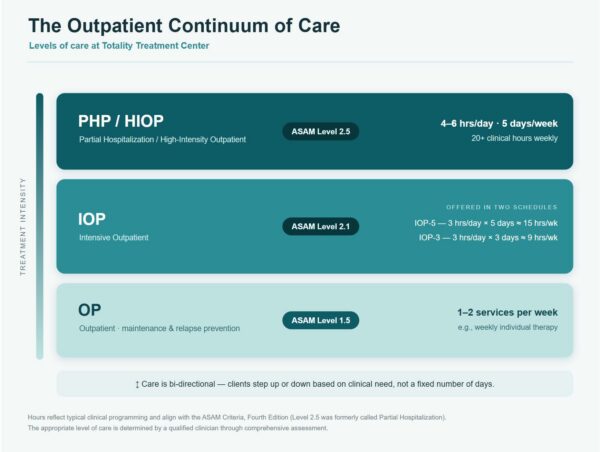
Step-down care is one of the most evidence-backed approaches to aftercare. Rather than moving from intensive outpatient programming directly to no support, step-down care reduces intensity gradually: from PHP to IOP, or from IOP to weekly outpatient therapy. The logic is that abrupt stops create sudden vulnerability.
A 2019 study published in Addiction Science and Clinical Practice followed 312 adults completing IOP and found that those who enrolled in step-down outpatient services were 38 percent more likely to maintain sobriety at the six-month mark than those who transitioned directly to self-managed recovery. The reduction in clinical contact was gradual enough that the support network could absorb the difference.
Before your last session, ask your treatment team for a written step-down schedule. That document should name specific appointment dates, providers, and the criteria for moving to a lower level of care.
Sober Living and Transitional Housing
Sober living homes in California provide a structured, substance-free living environment for people who have completed or are completing treatment. They differ from inpatient care in that residents maintain more independence while still living within a community of peers in recovery. They are not required for everyone, but they are particularly valuable for people whose home environment is unstable or where substances are present.
A 2010 study by Alcohol Research Group researchers Polcin and Korcha, which followed 245 residents of California sober living homes over 18 months, found significant improvements in alcohol and drug use, employment, and psychiatric symptoms. Housing stability was the single strongest predictor of sustained recovery at 12 months. The finding has held up in subsequent research.
Identify at least two sober living options in your area before discharge, not after. Waiting until you are out of treatment to research housing options adds unnecessary friction at the most vulnerable point in recovery.
Alumni Programs
Structured alumni programs extend the therapeutic relationship past discharge through regular check-ins, peer connection, and milestone recognition. They are not social events; they are a clinical extension that keeps people connected to the recovery community when the intensity of treatment fades.
A 2017 study in the Journal of Substance Abuse Treatment found that participation in formal alumni programs reduced 12-month relapse rates by 26 percent compared to non-participants, controlling for treatment type and severity. The mechanism is accountability: when people know someone will check in after 30 days, 90 days, and six months, they are less likely to quietly relapse in isolation.
Before your final session, confirm whether your outpatient program has a formal alumni structure and enroll in it. Passive availability is not enough. Active enrollment means you are already in the system when the check-in happens.
12-Step and Peer Recovery Meetings
AA, NA, SMART Recovery, and similar peer support formats are available throughout California both in person and via telehealth. SMART Recovery, in particular, has grown its California telehealth presence substantially since 2020, making it accessible in rural counties where in-person meetings are sparse.
A 2020 study by Stanford researcher Keith Humphreys and colleagues, published in Cochrane Database of Systematic Reviews, analyzed data from 27 studies involving 10,565 participants and found that AA involvement was associated with higher rates of continuous abstinence than other treatments across multiple time points. Regular meeting attendance, not occasional attendance, drove the effect.
Attend one meeting before your last outpatient session. The first meeting after discharge is the hardest to get to. Doing it while you are still in treatment removes that barrier.
How to Build an Aftercare Plan That Holds
A 2014 study published in Drug and Alcohol Dependence examined discharge planning practices across 208 substance use treatment programs. Programs that completed structured discharge planning, meaning documented triggers, scheduled appointments, and named emergency contacts, had significantly better 30-day re-engagement rates than those relying on verbal recommendations alone. The difference was not complexity. It was specificity.
Building an aftercare plan that holds starts with identifying your personal triggers. These are not generic stressors; they are the specific situations, relationships, or emotional states that have preceded substance use in your own history. Name them explicitly in your plan.
From there, the plan maps the first 30 days concretely: which appointments are already scheduled, which meetings you are attending and when, who your emergency contacts are and in what order you call them, and what you do if you feel a craving during a window when support is not immediately available. Vague plans fail. Plans with dates, names, and phone numbers do not.
Whether to Get a Sponsor
A sponsor is someone with sustained sobriety in a 12-step program who provides direct, experience-based guidance through your own recovery. The relationship is not therapy, but it is also not casual mentorship. A good sponsor has navigated the situations you are likely to face and is available when professional support is not.
A 2009 study published in Alcoholism: Clinical and Experimental Research followed 1,706 individuals in AA over 16 years and found that having a sponsor was one of the strongest independent predictors of sustained sobriety, with sponsored members showing 33 percent higher rates of abstinence at 16 years than non-sponsored members. The effect was not explained by meeting frequency alone.
If you are in a 12-step program, ask someone whose sobriety you respect before your discharge date. Not after. Waiting until you are out of treatment means approaching a stranger without the support system your treatment team currently provides.
The Role of Ongoing Therapy After Outpatient Treatment
Individual therapy does not pause when outpatient rehab ends. It continues, ideally with the same therapist or one already introduced during treatment. The modalities most commonly used in aftercare include cognitive behavioral therapy (CBT) for identifying and reframing distorted thinking, dialectical behavior therapy (DBT) for emotional regulation and distress tolerance, and EMDR for people whose substance use is tied to unprocessed trauma.
A 2018 meta-analysis in JAMA Psychiatry reviewed 53 trials involving more than 4,000 participants and found that CBT-based relapse prevention therapy reduced relapse risk by 58 percent over 12 months compared to minimal aftercare. The effect was strongest when therapy began before discharge and continued without a gap.
Book your first post-discharge therapy appointment before your last outpatient session. A scheduled appointment is the difference between intention and action, and rebuilding a stable daily structure after treatment depends on that structure being in place from day one.
Relapse Prevention: The Practical Framework
A 2018 study in the Journal of Studies on Alcohol and Drugs, which analyzed data from 563 adults in early recovery, found that those who could identify their personal warning signs before they escalated were 2.4 times more likely to seek help before a full relapse occurred. Warning signs are not the relapse itself. They are the conditions and behaviors that precede it, and recognizing them is a trainable skill.
The HALT model provides a straightforward framework: Hungry, Angry, Lonely, Tired. These four physical and emotional states are the most common precursors to cravings and high-risk decisions. When any of them is present, the risk of returning to substances increases. When two or more are present simultaneously, the risk is substantially higher.
A relapse prevention plan contains four components: a written list of personal triggers, a specific coping action for each trigger, a ranked list of people to call when coping alone is not working, and a clear threshold for when to return to a higher level of care. Knowing how to prevent relapse after leaving IOP requires more than general awareness. It requires a plan specific enough to use under stress.
Write your top three triggers and one coping action for each on a note in your phone. Not in a notebook you will not carry. On your phone, which is always with you.
How Family and Friends Support Recovery After Rehab
A 2021 study published in Frontiers in Psychiatry analyzed aftercare outcomes across 1,200 individuals and found that strong family involvement in formal aftercare, meaning participation in family therapy, structured communication, and boundary-setting, was associated with a 43 percent reduction in 12-month relapse rates. The finding held across substance types and treatment durations.
Family involvement helps most when it is structured. Unstructured support, where loved ones respond to whatever the person in recovery presents, can slide into enabling without either party recognizing it. Structured involvement means attending family therapy sessions, following the guidance of the clinical team on boundaries, and knowing the difference between supporting recovery and protecting someone from its consequences.
If a loved one shows warning signs, the action is not confrontation. It is contact with the clinical team and a direct conversation about returning to a higher level of care. The goal is to close the gap before a full relapse occurs. Repairing trust and communication patterns is a longer process, but it starts with the family member or close friend who will serve as the primary accountability contact.
Identify one person in your support network who will be your accountability contact and tell them this week, before discharge.
Navigating Aftercare in California: Resources and Coverage
According to SAMHSA’s 2022 National Survey on Drug Use and Health, 93.5 percent of people who needed but did not receive substance use treatment in the past year cited cost or insurance as the primary barrier. California has more coverage options than most states, and using them requires knowing specifically what to ask for.
Major private insurance plans accepted in California, including Aetna, Cigna, Anthem, HealthNet, and Ambetter, as well as Covered California marketplace plans, are required under the Mental Health Parity and Addiction Equity Act to cover substance use disorder treatment at parity with medical benefits. In practice, this means outpatient therapy, medication-assisted treatment (MAT) such as buprenorphine or naltrexone, and in many cases peer support services are covered. Telehealth services for behavioral health are also covered under most of these plans following California’s telehealth parity law.
California’s Department of Health Care Services (DHCS) administers county behavioral health programs that provide aftercare services on a sliding scale for those whose insurance coverage has gaps. Every county in California has a behavioral health department. These programs are not only for Medi-Cal recipients; many are open to uninsured and underinsured individuals as well.
Call your insurance provider this week and ask specifically which aftercare services are covered under your plan, including outpatient therapy, MAT, and peer support. Ask for the authorization process for each. Do not wait until discharge to have that conversation.
What to Try This Week
The research on aftercare converges on one consistent finding: the gap between the last day of outpatient treatment and the first aftercare contact is the most dangerous window in early recovery. Every day that gap is open, the likelihood of relapse increases. Closing it is the single highest-leverage action available.
Schedule your first post-discharge appointment before treatment ends. Not the week after. Before your last session. Whether that appointment is a therapy session, a step-down outpatient intake, or a sober living orientation meeting does not matter as much as having the date on the calendar. That one action, taken while you still have the support of your treatment team around you, changes the trajectory of what comes next, including how you approach returning to work and the rest of life after treatment.