How to Build the Right Support Network During Treatment (Even If You’re Starting from Scratch)
Building a support network during treatment for mental health, substance use, or co-occurring conditions is one of the most important things you can do for your recovery — and one of the hardest. If you feel like you do not have anyone to lean on right now, or you are unsure how to ask for help while managing everything else treatment asks of you, that is more common than you might think.
The most effective support networks during outpatient treatment tend to combine four layers: your clinical treatment team, peer connections inside your program, personal relationships outside of treatment, and community or group-based support. You do not need to build all four layers at once. This guide walks through how to identify what you actually need, where to start looking, how to ask for help in ways that feel manageable, and what to do when the people around you are not helping the way you hoped.
Why Building Support During Treatment Feels So Hard
If you are in treatment right now — or thinking about starting — you already know that recovery takes energy. Real energy. The kind that does not leave much room for making phone calls, explaining your situation to people who may not understand, or figuring out which support group meets on which night.
Many people entering outpatient care for substance use, mental health concerns, or dual diagnosis challenges arrive with relationships that feel strained, distant, or complicated. Some feel embarrassed about needing help. Others have spent months or years trying to manage everything alone and are exhausted by it. The idea of “building a network” can sound like one more overwhelming task on top of a treatment schedule that already asks a lot.
That feeling is valid. And it does not mean you are doing something wrong. It means you are human, and you are navigating something genuinely difficult. The good news is that you likely already have more support available than you realize — starting with the treatment program itself.
Your Treatment Program Is Already Your First Layer of Support
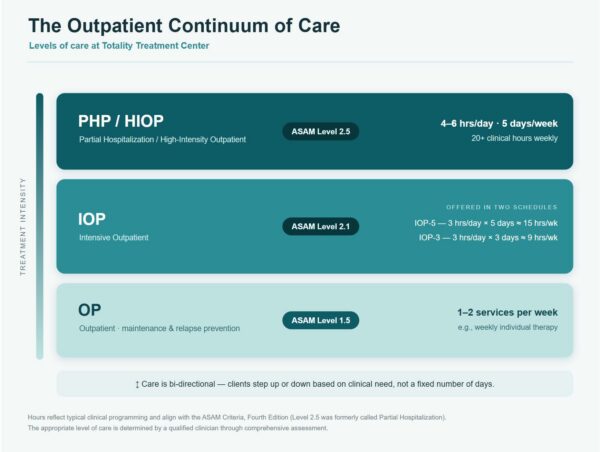
One thing that often goes unrecognized is that structured outpatient treatment — whether it is a Partial Hospitalization Program (PHP), an Intensive Outpatient Program (IOP), or another level of care — already creates a built-in community around you. You do not have to build your entire support network from the outside in. You can start from where you already are.
The Clinical Team You Already Have
In a well-structured outpatient program, you are not working with just one person. Your treatment team may include individual therapists, group facilitators, case managers, and clinical staff who coordinate different parts of your care. Each of these roles serves a different function in your support system.
At Totality Treatment Center, for example, the clinical team is designed to work together so that the burden of coordinating care does not fall on you alone. Case managers can help connect you to outside resources, navigate logistics, and address practical barriers that might otherwise pull your attention away from recovery. Individual therapists provide a space for the deeper, more personal work. Group facilitators help create a structured environment where peer connection can happen naturally.
If you are not sure who on your treatment team handles what, it is worth asking. A simple question like “Who should I talk to about finding additional support outside of our sessions?” can open a door you did not know was there.
The Peer Community Inside Group-Based Programs
Group therapy and structured programming — the kind offered in PHP, IOP, and similar levels of care — do something that individual therapy alone cannot. They put you in a room with other people who are going through something similar. That shared experience, even when it is not spoken about directly, creates a kind of connection that can be hard to find anywhere else.
You do not need to become best friends with everyone in your program. But allowing yourself to be present in group settings, to listen and be heard, is itself a form of building support. Over time, many people find that the peers they met during treatment become some of the most important relationships in their recovery.
At Totality Treatment Center, group-based programming is a core part of both PHP and IOP tracks. The community that forms within these groups is intentional — it is designed to help people feel less alone during a time that can otherwise feel isolating.
What to Ask Your Treatment Team About Outside Resources
Your clinical team can often connect you to support that exists beyond the walls of the treatment center. But they may not always know exactly what you need unless you tell them. Here are a few specific questions worth asking:
- “Are there peer support groups you recommend for someone managing both mental health and substance use concerns?”
- “Can my case manager help me find community resources for housing, transportation, or daily living support?”
- “Are there alumni groups or community connections I can join after I finish this program?”
- “I’m feeling isolated outside of sessions. Is there anything you would suggest?”
Asking these questions is not a sign of weakness. It is one of the most useful things you can do for yourself during treatment.
The Four Types of Support You Need — and Where to Find Each One
Not all support looks the same, and not all of it comes from the same people. Understanding the different types of support can help you figure out what is missing and where to look for it — without expecting any single person to fill every role.
Emotional Support: People Who Listen Without Trying to Fix
Emotional support comes from people who can sit with you in hard moments without rushing to solve the problem. They listen. They do not judge. They allow you to experience your feelings without centering themselves in the process.
This could be a trusted friend, a family member, a therapist, or someone else in your treatment program. The person does not need to have a deep understanding of your diagnosis — what matters is that you feel safe enough to be genuine around them.
If you are not sure whether someone in your life can offer this, start small. Share something minor and see how they respond. Do they listen? Do they try to give advice you did not ask for? Do they make it about themselves? Their response to something small will tell you a lot about whether they can handle something bigger.
Practical Support: People Who Help with the Logistics
Practical support is help with the tangible, everyday things — a ride to an appointment, help with groceries, someone who picks up the phone when your insurance company puts you on hold for the third time.
This type of support often gets overlooked because it does not feel “therapeutic.” But when you are managing a treatment schedule, daily responsibilities, and the emotional weight of recovery, practical help can make the difference between staying engaged in care and feeling like everything is falling apart.
Case management services, like those offered at Totality Treatment Center, are specifically designed to help with this kind of support. A case manager can assist with coordinating logistics, connecting you to community services, and handling some of the administrative weight that tends to pile up during treatment — especially when you are trying to balance care with work, school, or family responsibilities.
Informational Support: People Who Help You Understand What You Are Going Through
Informational support means having access to people or resources that help you make sense of your treatment, your condition, and your options. This might come from your therapist, a psychiatrist, a social worker, a support group facilitator, or even reliable educational resources.
This type of support is especially important when you are navigating dual diagnosis — managing both a mental health condition and substance use at the same time. Understanding how these conditions interact, what your treatment plan is designed to address, and what questions to ask your care team can help you feel more in control of a process that sometimes feels like it is happening to you rather than with you.
If you ever feel confused about what is happening in your treatment, say so. A good clinical team will welcome that question, not dismiss it.
Normalizing Support: People Who Help You Feel Like a Whole Person
Normalizing support is the type most often forgotten — and sometimes the most needed. These are the people and activities that remind you that you are more than your diagnosis. They help you feel like a person, not just a patient.
This might look like a friend who invites you to do something ordinary — a meal, a walk, a conversation about something that has nothing to do with treatment. It might be a hobby group, a faith community, a gym, or a creative space. The point is that these connections anchor you to a life outside of recovery, which is part of what recovery is ultimately for.
Not every relationship in your life needs to be about treatment. Some of the best support comes from people who simply treat you like you.
How to Find Peer Support Groups That Actually Fit
Peer support groups are one of the most commonly recommended resources during treatment, and for good reason. Being around others who understand your experience — not because they read about it, but because they have lived it — can reduce the sense of isolation that makes recovery harder than it needs to be.
But not every group is the right fit. Finding a group that actually helps starts with knowing what to look for.
In-Person Groups: Where to Look and What to Ask
Your treatment team is the best first resource for finding in-person groups. They can often recommend groups that are relevant to your specific needs — whether that is substance use recovery, a mental health condition, or co-occurring dual diagnosis concerns.
When evaluating a group, consider asking:
- Is the group peer-led, professionally facilitated, or a combination?
- Is the group focused on a specific condition, or is it general?
- How large is the group typically?
- Is confidentiality expected and enforced?
- Am I allowed to attend once before committing?
It is completely reasonable to try a group once and decide it is not the right fit. That is not failure — it is discernment.
Online Communities: How to Evaluate Safety and Quality
Online support communities can be a meaningful supplement, especially if your schedule, location, or comfort level makes in-person attendance difficult. Telehealth options and virtual support groups have expanded significantly, and many people find them genuinely helpful.
When evaluating an online community, look for:
- Clear moderation and community guidelines
- A focus on your specific area of concern (mental health, substance use, dual diagnosis)
- Respectful, non-judgmental interactions
- Privacy protections — avoid groups that require you to share your full name or personal details publicly
At Totality Treatment Center, telehealth programming is available as part of IOP and other outpatient services, which means that even when you cannot be physically present, you can still access clinical support and peer connection through a structured, secure platform.
The Difference Between a Support Group and Group Therapy
This distinction matters and is often unclear. Group therapy is a clinical intervention facilitated by a licensed professional. It is part of a treatment plan, typically occurs within a treatment setting, and focuses on therapeutic goals. A support group is a peer-driven community gathering, often organized around a shared experience, and does not typically involve clinical treatment.
Both can be valuable. They serve different purposes. Group therapy, like the sessions offered within Totality Treatment Center’s PHP and IOP programming, provides structured clinical care in a group setting. Peer support groups provide ongoing community connection that can continue long after formal treatment ends.
You do not have to choose one or the other. Many people benefit from both.
How to Ask for Help Without Feeling Like a Burden
This is the part that most guides skip too quickly. Knowing that you should ask for help is different from knowing how to ask for help — especially when you already feel vulnerable, tired, or unsure whether the person you are asking will respond the way you need.
Here is what tends to work better than vague requests.
Instead of: “Feel free to reach out if there is ever anything I can do.”
Try being specific:
“My treatment runs Tuesday mornings. Would you be open to giving me a ride — even just once or twice a month?”
“Things have been really difficult lately. I am not looking for solutions — I just want someone to send me a quick message a few times a week to check in. Is that something you could do?”
“While I am in treatment, it would mean a lot to spend time together doing something ordinary — without making it about how I am doing. Just normal time together.”
“It helps me to know that someone outside my program is aware of my schedule. Would you be comfortable if I shared it with you, just as a point of contact?”
Specific requests are easier for people to say yes to. They remove the guesswork. And they help you get what you actually need instead of what someone assumes you need.
If the idea of saying these words out loud feels overwhelming, consider writing them down first — as a text, an email, or even notes for yourself before a conversation. Asking for help is a skill, and like any skill, it gets easier with practice.
How to Set Boundaries with People Who Drain Your Energy
Not everyone who wants to be part of your support network should be. And not every well-meaning person actually helps.
When Well-Meaning People Give Harmful Advice
Some people in your life may try to help by offering opinions about your treatment, your medication, your program, or your choices — based on something they read online, heard from a friend, or simply believe to be true. Their intentions may be good. The impact may not be.
You are allowed to redirect these conversations. A few ways to do that clearly and kindly:
“It means a lot that you care about me. At the moment, I am committed to the treatment plan my care team and I put together, and staying on course is what I need most right now.”
“I know your heart is in the right place, but advice about my treatment — even when it comes from a good place — actually adds to my stress. The most helpful thing you can offer is simply showing up.”
You do not owe anyone an explanation of your clinical decisions. Your treatment plan was developed with professionals who understand your specific needs. Protecting that process is not rude — it is responsible.
When Someone in Your Life Is Not Supportive of Your Treatment
This is harder. Sometimes the people closest to you — a partner, a parent, a close friend — do not fully support your decision to be in treatment. They may minimize what you are going through, question whether you really need this level of care, or create conflict around your schedule.
If this is your situation, you are not alone. It is one of the most common challenges people face during outpatient treatment, and it is something your clinical team can help you navigate. A therapist or case manager can work with you on communication strategies, help you set boundaries, and in some cases, facilitate family conversations when appropriate.
At Totality Treatment Center, the clinical team understands that recovery does not happen in isolation from the rest of your life. Relationships, family dynamics, and social pressures are all part of what treatment addresses — not just symptoms or behaviors.
What to Do If You Feel Like You Have No One
If you are reading this and thinking, “I don’t have anyone to put in these categories,” — that is okay. You are not behind. You are not broken. Many people begin treatment without a strong support network, and many build one during the process.
Here is a place to start:
- Start with your treatment team. They are already in your corner. Tell them that you feel isolated and ask what resources or connections they can offer. This is exactly the kind of thing case managers are trained to help with.
- Attend one group — in person or online — without pressure to participate. You can listen first. You do not have to share your story the first time. Just being in a room with other people who understand is a step forward.
- Make one small connection outside of treatment. It does not need to be deep. A regular conversation with a neighbor, a coworker, or someone at a community gathering counts. Normalizing support — the kind that makes you feel like a whole person — can come from the simplest interactions.
- Let your program carry some of the weight. Structured outpatient care, including PHP and IOP, is designed to provide daily or near-daily connection with a clinical team and a peer group. If you do not have a support system outside of treatment yet, the program itself can hold that space while you build one.
Totality Treatment Center’s PHP, IOP, and Night Track programs are built around this understanding. Many people who come to Totality arrive feeling overwhelmed by the idea of managing recovery without a community around them. The structured environment — including group therapy, individual sessions, and case management — is designed to provide that community from day one, whether you attend during the day, in the evening through the Night Track, or through telehealth.
Your Support Network Will Change — and That Is Normal
The support you need at the beginning of treatment is not the same as the support you need three months in, or six months after completing a program. This is not a sign that something went wrong. It is a sign that you are growing.
In early treatment, you may rely heavily on your clinical team and the structure of your program. Over time, you may find that peer connections, personal relationships, and community groups play a larger role. Some relationships will deepen. Others may fade. A few may need to end.
Periodically checking in with yourself about your support network is a healthy practice. Consider asking:
- Do I feel supported right now, or am I carrying too much alone?
- Are there types of support I need more of — practical help, emotional connection, information, or normalcy?
- Is anyone in my network consistently draining me or undermining my treatment?
- Have my needs changed since I last thought about this?
If you are still in a treatment program, these are excellent things to bring to a session with your therapist or case manager. At Totality Treatment Center, clinical teams work with each person to assess and adjust support plans as treatment progresses — because recovery is not a straight line, and neither is the support that sustains it.
A Note About Dual Diagnosis and Specialized Support
If you are managing both a mental health condition and a substance use concern — what clinicians call dual diagnosis or co-occurring conditions — your support needs may be more specific than what general resources provide. A support group focused solely on addiction may not address the mental health dimension. A mental health group may not understand the substance use side.
This is one of the reasons specialized treatment programs exist. Totality Treatment Center’s outpatient programs are designed specifically for adults managing dual diagnosis, which means the group therapy, clinical support, and peer community within the program already account for both sides of that experience. If you are looking for outside groups as well, ask your treatment team to recommend options that understand co-occurring conditions rather than treating them separately.
Frequently Asked Questions
What if I do not have family or close friends to lean on during treatment?
Many people begin treatment without a strong personal support network. That is one of the reasons structured programs like PHP and IOP include group therapy and community-based care — they provide built-in peer connection while you are building outside relationships. Your treatment team, including your case manager, can also help connect you to community resources and peer support groups.
How do I find support groups for my specific condition?
Start by asking your treatment team. They often know which groups in the area are well-run and relevant to your needs. You can also search through reputable national behavioral health organizations, your insurance provider’s resource directory, or local community health centers. Look for groups that match your specific concerns — mental health, substance use, or dual diagnosis — rather than general wellness groups.
What is the difference between a support group and group therapy?
Group therapy is a clinical intervention led by a licensed professional, focused on therapeutic goals, and typically part of a formal treatment plan. A support group is usually peer-led or community-organized, centered on shared experience, and not a substitute for clinical care. Both can be valuable, and many people benefit from participating in each.
How do I ask someone for help without feeling like a burden?
Concrete, specific requests are far easier for others to act on. Rather than a general offer like “let me know if you need anything,” name one clear thing you need — a scheduled check-in, transportation to an appointment, or regular time spent together doing something low-key. Most people genuinely want to help but need direction to do so effectively.
Can online support groups really help?
Yes. Online support communities and telehealth-based group programming can provide meaningful connection, especially when scheduling, transportation, or comfort level makes in-person attendance difficult. The key is finding groups that are well-moderated, condition-specific, and protective of your privacy. Ask your treatment team for recommendations.
What if someone in my support network is making treatment harder?
This happens more often than people expect. If someone close to you is minimizing your treatment, giving unsolicited advice, or creating conflict around your recovery, talk to your therapist or case manager. They can help you develop communication strategies, set boundaries, and, in some situations, facilitate conversations with family members or close contacts.
You Do Not Have to Build This Alone
Building a support network during treatment is not about assembling a perfect team overnight. It is about slowly, honestly creating connections that help you feel less alone — and letting the people and programs around you carry some of the weight while you focus on getting well.
If you are looking for outpatient treatment that already has community, clinical support, and case management built in, Totality Treatment Center may be able to help. Our PHP, IOP, and Night Track programs are designed for adults navigating mental health, substance use, or dual diagnosis concerns who need structured care that fits around their real lives — including day, evening, telehealth, and in-person options.
A clinical assessment can help determine which level of care and schedule may be the most appropriate fit for your needs. If you have questions about programming, scheduling, insurance compatibility, or what to expect, call the Totality Treatment Center admissions team. Our team is ready to listen, address your questions, and help you identify the right next step — moving at whatever pace works for you.