Recovery doesn’t end when treatment does, and the most effective sobriety planning and identity rebuilding in Los Angeles starts long before a client walks out the door. This article breaks down what those two processes actually involve, why they work together rather than separately, and what a structured approach to both looks like in practice.
What Sobriety Planning and Identity Rebuilding Actually Mean
Sobriety planning is the structured, forward-looking process of building a sustainable life in recovery: mapping out treatment modalities, support systems, crisis protocols, and accountability structures before the pressure of daily life arrives. Identity rebuilding is the parallel psychological work of answering a harder question: who are you without substances?
These two processes are not separate tracks. A 2021 study published in the Journal of Substance Abuse Treatment found that individuals who engaged in active identity change work during treatment, not just behavioral modification, showed significantly higher rates of sustained sobriety at 12 and 24 months. The mechanism is straightforward: behavior follows identity. When a person builds a coherent, valued sense of self in recovery, staying sober becomes consistent with who they are rather than a daily act of willpower against who they were.
Los Angeles matters here for reasons beyond geography. The city’s scale and population diversity create a recovery environment with genuine infrastructure: specialized outpatient programs, peer support networks, culturally specific services, and a telehealth system that extends access statewide. That infrastructure makes Los Angeles one of the most substantively useful places in the country to do this work.
Why Identity Is the Missing Piece in Most Sobriety Plans
A 2020 study in Addictive Behaviors tracked 312 adults in early recovery and found that identity confusion, defined as lacking a stable sense of self outside substance use, was one of the strongest predictors of relapse within the first year. Not stress. Not cravings. Identity confusion.
The mechanism is not complicated once you see it clearly. Substance use does not just create physical dependence. It builds a social world: roles, routines, relationships, and a daily structure that organizes time and purpose. When sobriety removes that structure, something has to replace it. A sobriety plan that only addresses behavior, what to avoid, what meetings to attend, what cravings to manage, without addressing the underlying identity vacuum, leaves that gap open. That gap is where relapse lives.
The Role of Co-Occurring Mental Health Diagnoses
According to SAMHSA’s 2023 National Survey on Drug Use and Health, approximately 21.5 million adults in the United States have both a substance use disorder and at least one co-occurring mental health condition. Among people actively seeking treatment, the percentage is higher. Untreated anxiety, depression, PTSD, or ADHD does not simply complicate sobriety , it directly destabilizes the identity formation work that recovery requires. A person trying to build a clear self-concept while managing unaddressed trauma or untreated depression is working with a structural disadvantage.
The practical step here is specific: get a dual-diagnosis assessment before finalizing any treatment plan. Not after. A program that begins with a thorough psychiatric and clinical evaluation can sequence treatment in the right order, treating the whole person rather than layering behavioral interventions on top of unaddressed mental health conditions.
How Substance Use Rewires Self-Perception
A 2019 review published in Neuroscience and Biobehavioral Reviews examined how prolonged substance use alters the default mode network, the brain system responsible for self-referential thinking and narrative construction. Extended substance use reshapes how a person interprets their own memories, motivations, and worth. The self-story that emerges is often shame-heavy, fragmented, and organized around the substance rather than around values, relationships, or goals.
Understanding this as a brain-based process removes the moral framing that makes identity work so difficult. The distorted self-perception that many people in early recovery carry is not a character flaw. It is a neurological pattern that responds to deliberate, structured intervention. That reframe is not just therapeutic , it opens the door to the identity work that actually holds.
Building a Sobriety Plan That Actually Holds
A sobriety plan is a document, not a disposition. The distinction matters. A 2018 study in Drug and Alcohol Dependence compared adults in treatment who completed written aftercare plans with those who made verbal commitments only. At 12 months, those with written structured plans had a 34% higher rate of sustained sobriety. Good intentions do not create accountability structures. Written plans do.
The core components of a sobriety plan that holds include: the treatment modality and clinical schedule, a map of personal triggers and high-risk situations, a named support network with contact information, a crisis protocol for acute moments, and a schedule for accountability check-ins. At Totality Treatment, aftercare planning begins on day one, not during the final week of treatment. That timing matters because discharge is not a finish line. It is a transition, and transitions require infrastructure that is already in place before they happen.
Evidence-Based Treatment Modalities in Los Angeles
The treatment modalities with the strongest research base for identity-integrated recovery are Cognitive Behavioral Therapy (CBT), Dialectical Behavior Therapy (DBT), Motivational Interviewing (MI), and Trauma-Informed Therapy. A 2022 meta-analysis in Addiction covering 47 randomized controlled trials confirmed that CBT produces durable changes in both substance use behavior and underlying cognitive patterns, including self-perception and self-efficacy. DBT, originally developed for borderline personality disorder, has strong evidence for populations where emotional dysregulation intersects with substance use. MI works directly at the level of motivation and self-concept, making it particularly useful in the identity rebuilding process.
Los Angeles outpatient programs offer all four within the same care pathway rather than as isolated options. When evaluating a program, ask specifically which of these modalities are available, how they are sequenced, and whether the clinical team integrates them or delivers them as disconnected services.
Relapse Prevention as a Structured Tool, Not a Warning
A 2019 study in Substance Abuse Treatment, Prevention, and Policy found that clients who completed written relapse prevention plans before discharge were significantly more likely to seek help at early warning signs rather than waiting until a full relapse had occurred. The difference between a written plan and a verbal commitment is that the written plan removes the decision-making burden from the moment of crisis.
A functional relapse prevention plan covers four things: the personal early warning signs that precede high-risk behavior, the specific high-risk situations and contexts to navigate, the names and contact information of people to call, and a 24-hour action protocol that removes ambiguity about what to do. The action for this week is to build a concrete plan for preventing relapse after stepping down from a structured program, using those four components as the framework.
Identity Rebuilding: The Psychological Work Underneath Recovery
William Miller’s foundational research on motivational enhancement, developed across decades of clinical study, consistently found that identity change, not just behavioral change, is the operative variable in sustained recovery. People who shifted how they described themselves, from “addict trying to stay sober” to “person in recovery building a new life,” showed markedly better long-term outcomes. The language is not cosmetic. It reflects a genuine reorientation of self-concept, and that reorientation is the work.
Identity rebuilding involves three interlocking processes: values clarification, role re-entry, and the construction of a coherent personal narrative. None of these are soft additions to clinical treatment. They are the clinical work.
Values Clarification as a Starting Point
Research on Acceptance and Commitment Therapy (ACT) consistently shows that values-based living is a strong predictor of sustained behavior change. A 2021 study in the Journal of Contextual Behavioral Science found that ACT participants who completed structured values clarification work early in treatment showed greater psychological flexibility and lower relapse rates at six months than those who received standard behavioral interventions alone.
The mechanism is direct: when daily behavior aligns with personally meaningful values rather than external rules or obligations, motivation is internally generated. That internal motivation is durable in a way that externally enforced compliance is not. A structured values exercise such as the ACT Values Card Sort gives this work a concrete starting point. Complete it before the next therapy session and bring the results into the conversation.
Rebuilding Roles: Professional, Family, and Social Identity
A 2020 study in Psychiatric Services found that employment within the first year of recovery was one of the most robust protective factors against relapse, independent of treatment type or substance. For single parents, returning to active parenting roles showed similar effects. For college students, re-engagement with academic community served the same function.
The thread across all three populations is the same: structured social roles provide external scaffolding for an identity that is still being rebuilt internally. Returning to professional life after treatment is not just a practical milestone. It is a clinical one. Identify one role you have stepped back from and take one concrete re-entry step this week, whether that is a conversation with a manager, a call to a family member, or a registration for a course.
Narrative Therapy and the Story You Tell About Yourself
A 2017 review in the International Journal of Mental Health and Addiction examined narrative therapy interventions across 14 studies of people in substance use treatment. Across those studies, the consistent finding was that shifting a person’s self-narrative from passive to active, from “addiction happened to me” to “I am someone moving through this,” produced measurable improvements in self-efficacy and treatment engagement.
The framing matters because the story a person tells about their addiction either positions them as a subject of forces outside their control or as an agent making choices and building something new. Both stories can be accurate as descriptions. Only one of them supports a durable recovery. Working with a therapist to rewrite one part of your personal story in agency-forward language is not a journaling exercise. It is a clinical intervention with documented outcomes.
Los Angeles as a Recovery Environment
According to data from the California Department of Health Care Services, Los Angeles County has the highest concentration of licensed outpatient substance use treatment facilities in the state, with over 400 certified programs operating across the county. A 2022 UCLA Luskin Institute report on behavioral health infrastructure in Southern California found that LA County’s recovery ecosystem, including peer support organizations, sober living networks, and community-based recovery services, is among the most developed in the United States.
That density is practically significant. It means a person in recovery in Los Angeles has access to specialized care, culturally specific programming, population-specific services, and peer community infrastructure that simply does not exist in most other places.
Outpatient and Telehealth Options Across California
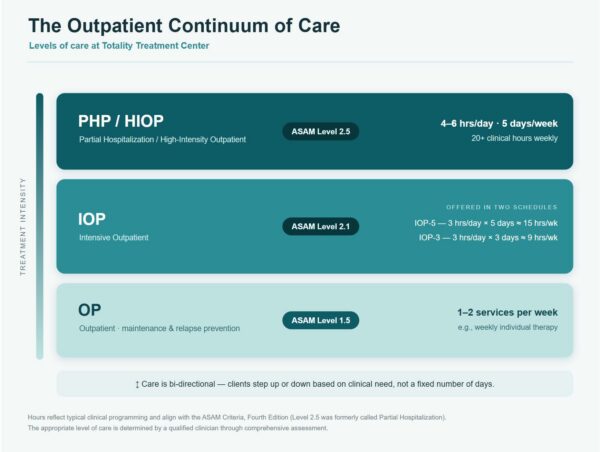
Intensive outpatient programs (IOPs) in Los Angeles typically provide 9 to 15 hours of structured clinical programming per week, allowing clients to maintain work, school, and family responsibilities while receiving treatment at a clinical level of intensity. That structure is the right fit for most adults who do not require medical detox or 24-hour supervision.
Statewide telehealth extends that access to clients across California who cannot access in-person services. Insurance coverage is a real barrier for many people, and it is worth naming directly: Aetna, Cigna, Anthem, HealthNet, Ambetter, and Covered California are all accepted, which removes the financial obstacle for a large portion of insured Californians. Verify your coverage before the end of the week using your insurer’s online benefits tool or by calling the program directly.
Peer Support and Community Infrastructure in LA
A 2021 study in Psychiatric Rehabilitation Journal followed 300 adults in recovery over 18 months and found that those with regular peer support contact, defined as at least one peer recovery coaching interaction per week, had a 40% lower rate of return to use compared to those without. The mechanism is not mysterious: people who have already navigated the same transition reduce the isolation of recovery and model a workable version of the life being built.
Los Angeles has the peer infrastructure to make this concrete. Recovery community organizations, sober living networks, and mutual aid groups operate across the city’s neighborhoods. Find and attend one peer-led meeting or community event in your area this week. Not because it will solve anything on its own, but because connection is a protective factor and isolation is a risk factor, and that distinction has data behind it.
Common Misconceptions About Sobriety Planning and Identity Work
The first misconception is that sobriety planning only matters in early recovery. A 2020 study in Alcoholism: Clinical and Experimental Research found that adults who returned to active planning, updating their aftercare structures and support networks, at 12 and 24 months showed better outcomes than those who treated their original plans as permanent. Sobriety planning is not a one-time document. It is a living structure that requires revision as life circumstances change.
The second misconception is that identity rebuilding is a supplemental or inspirational add-on rather than clinical work. The research reviewed above makes the opposite case clearly. Identity formation predicts relapse. Values clarification predicts sustained motivation. Narrative structure predicts self-efficacy. These are not soft outcomes. They are measurable clinical variables with peer-reviewed evidence behind them.
The third misconception is that effective treatment requires a residential setting. A 2019 Cochrane Review of outpatient versus residential treatment for alcohol use disorder found no significant difference in 12-month sobriety outcomes between well-structured outpatient programs and residential ones for adults without acute medical needs. The structure, clinical quality, and continuity of care matter. The setting is secondary.
What Changes When You Take Both Seriously
The single most useful step at this stage is to schedule a dual-diagnosis intake assessment at a Los Angeles outpatient program that delivers both structured relapse prevention planning and identity-integrated therapy within the same care pathway. When you make that call, ask three specific questions: whether the program includes a co-occurring mental health assessment as part of intake, how aftercare and relapse prevention planning are structured, and what support exists after discharge, not just during treatment.
At Totality Treatment, 92% of clients pursue therapy, education, or employment after completing the program. That outcome is not an accident. It reflects what happens when discharge planning begins on day one and when the clinical work addresses behavior and identity together rather than treating one as primary and the other as optional.