Returning to work after addiction treatment is one of the most high-stakes transitions in early recovery, and how you manage the first few weeks shapes outcomes far beyond your career. This guide covers the legal protections you’re entitled to, how to talk to your employer without oversharing, how to build a daily structure that supports your sobriety, and when to reconsider whether a job is actually safe for your recovery.
What the Research Says About Going Back to Work After Treatment
A 2021 study published in the Journal of Substance Abuse Treatment, analyzing outcomes for over 1,200 adults completing residential and outpatient programs, found that stable employment within 90 days of discharge was one of the strongest predictors of sustained recovery at the 12-month mark. Work provides structure, social connection, and purpose, three factors that directly reduce relapse risk. But the same study noted that unmanaged workplace stress, without active coping strategies in place, was associated with a 40% higher rate of early relapse.
The takeaway is straightforward: employment helps recovery, but only when the return is intentional. Walking back in without a plan, without legal knowledge, and without a protected aftercare schedule turns one of your greatest recovery assets into your biggest vulnerability.
Know Your Legal Rights Before You Walk Back In
Under the Americans with Disabilities Act, a history of substance use disorder qualifies as a disability. That means you have federally protected rights: your employer cannot demote, terminate, or discriminate against you for having sought treatment. The Family and Medical Leave Act (FMLA) goes further, allowing eligible employees to take up to 12 weeks of unpaid, job-protected leave per year for a serious health condition, which includes treatment for addiction. You do not have to disclose a diagnosis to invoke FMLA. A physician certifying the medical necessity of leave is sufficient.
What Your Employer Can and Cannot Ask
Your employer cannot ask you for a specific diagnosis. They cannot require you to explain what you were treated for, and they cannot use your treatment history as grounds for demotion or termination. What they can ask is whether you are able to perform the essential functions of your job, with or without reasonable accommodation.
Reasonable accommodations are concrete and common. A modified start time to protect a morning outpatient appointment qualifies. A brief schedule adjustment for a weekly therapy session qualifies. These requests do not require you to explain why, only that a medical need exists and that the adjustment does not create undue hardship for the employer.
How to Document Your Return
A return-to-work agreement is a written document that outlines expectations, accommodations, and conditions for your reinstatement. Read it carefully before signing. Push back on vague language around “fitness for duty” that could be used to justify future termination, and confirm in writing that any accommodations discussed verbally are included. Before you sign anything, have someone in your corner, whether a union representative, an HR contact you trust, or legal counsel, review the document with you. One concrete step: request a copy of the agreement at least 48 hours before your return date so you have time to read and respond.
How to Talk to Your Employer (Without Saying More Than You Need To)
A 2016 study from Johns Hopkins Bloomberg School of Public Health surveyed over 700 HR professionals and found that employees who disclosed a substance use disorder were rated as significantly less promotable, even when their performance records were identical to peers. The stigma is real, and full disclosure is rarely required.
What works is a narrow, professional statement. Something like: “I took medical leave for a health condition that’s been treated. I’m ready to return and have a few scheduling accommodations to request.” That sentence does two things: it closes the door on follow-up questions and it opens the door to the accommodations you need. You are not required to name the condition.
Building a Workplace Support System
A 2019 study in Drug and Alcohol Dependence, following 500 adults in early recovery, found that individuals with at least one supportive social contact in their work environment had relapse rates 28% lower than those who reported social isolation at work.
Identify one or two colleagues you trust, not to confide in fully, but enough to know they are safe. If your employer offers an Employee Assistance Program, use it. EAPs provide confidential counseling, referrals, and sometimes short-term therapy at no cost, and that confidentiality is legally protected. Set a clear internal boundary around who knows what, and commit to it. Rebuilding trust in your personal relationships after treatment follows similar logic: selective, intentional disclosure protects you without requiring isolation.
Build a Daily Routine That Protects Your Recovery
A 2020 study from the University of New Mexico, tracking 300 adults in early recovery over 18 months, found that those with structured morning routines reported 33% fewer high-craving episodes during the workday. The mechanism is direct: structured time reduces decision fatigue, which reduces the mental space available for compulsive thinking. Recovery benefits from a tight schedule, not a loose one.
The action is specific. Build a morning anchor before the workday starts. This means a fixed wake time, a brief but non-negotiable activity (a walk, a meditation, a meal), and a clear transition into work mode. This is not about productivity culture. It is about filling the unstructured space that early recovery makes dangerous.
Managing Stress Before It Manages You
A 2022 report from the Substance Abuse and Mental Health Services Administration (SAMHSA) identified occupational stress as the leading environmental trigger for relapse in the first year of recovery, ahead of social events and relationship conflict. The warning pattern to watch for is not the sudden craving. It is the slow accumulation of small stressors that goes unaddressed for days until the pressure becomes unmanageable.
One technique that works in a work setting: a two-minute reset. When you notice the pressure building, step away from your desk, breathe slowly for two minutes, and name what is actually happening, not the catastrophic version, the factual one. This interrupts the escalation cycle before it reaches a dangerous threshold.
Protecting Your Aftercare Schedule
Outpatient appointments, therapy sessions, and support group meetings are not optional. They go on the calendar as recurring, non-negotiable blocks before anything else gets scheduled. At work, you do not have to explain what the time is for. “Medical appointment” is sufficient. Blocking this time in advance, before your manager begins scheduling meetings around your calendar, protects it without requiring a conversation.
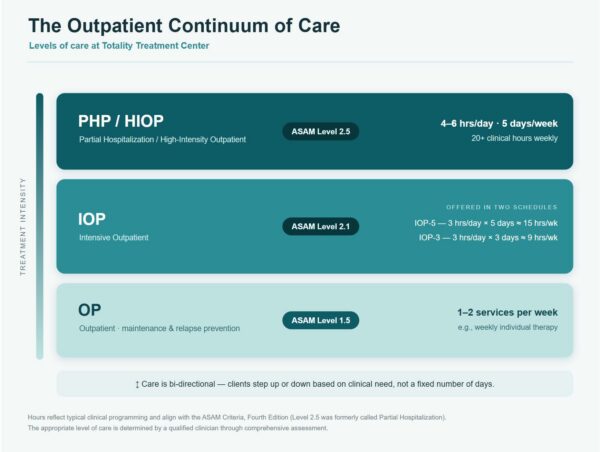
Aftercare planning for outpatient recovery in California should start during treatment, not after discharge. When aftercare is built into the structure from day one, the transition back to work is not a break from recovery; it runs alongside it.
What to Do If the Workplace Feels Unsafe for Your Recovery
Not every job is a safe place to return to. A 2018 analysis in Occupational and Environmental Medicine, examining data from 22 industries, found that workers in hospitality, construction, and food service had relapse rates two to three times higher than the general recovery population, driven by drinking culture, irregular hours, and chronic high stress.
Returning to the same job makes sense when the role itself is not the problem. If the work was meaningful, your colleagues are supportive, and the stress is manageable, the structure of employment works in your favor. But if the job involves regular exposure to substances, a culture that normalizes heavy drinking, or management that creates toxic stress, returning is not a neutral decision. It is a risk calculation that deserves an honest answer.
Planning what comes next after treatment means asking whether the job you are returning to fits the life you are building, not just the income you need.
What to Try This Week
Identify the single highest-risk moment in your first week back at work. For most people, it is one of three things: a social situation where drinking is present, a high-pressure interaction with a manager or colleague, or an unstructured block of time that has no plan attached to it.
Pick that moment. Write one sentence about what you will do when it arrives: a script, a person you will text, a place you will go, a two-minute technique you will use. One sentence is enough to turn a vague threat into a concrete plan, and a concrete plan is the difference between getting through the week and not.