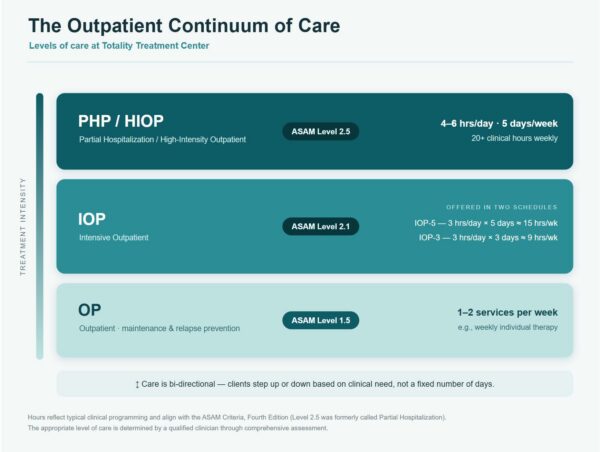
Overview of intensive outpatient programs
When you’re exploring options for recovery, an IOP for mental health and substance abuse offers a structured level of outpatient care that bridges traditional therapy and partial hospitalization. This intensive outpatient program helps you address psychological challenges and substance use while continuing to live at home or in a sober living environment. Participants generally attend treatment for at least nine hours per week, often split into three three-hour sessions (American Addiction Centers).
Intensive outpatient care excels at balancing independence and support. You retain responsibilities at work or school, while receiving individual counseling, group therapy, and psychoeducation. By combining evidence-based practices such as cognitive behavioral therapy, motivational interviewing, and 12-step facilitation, matrix model IOPs help you build coping skills, manage triggers, and reduce the likelihood of relapse (American Addiction Centers).
Nearly 45 percent of Americans hesitate to seek help for mental health issues, contributing to the fact that 94 percent of people with substance use disorders did not receive any treatment in 2021 (AM Behavioral Health). An intensive outpatient program can remove barriers by offering flexible scheduling and a less restrictive setting.
Benefits of outpatient programs
Intensive outpatient services deliver a range of advantages tailored to your recovery journey. In addition to the clinical interventions you would receive in inpatient care, you benefit from staying connected to your support network and daily routines. Key benefits include:
- Flexibility of living at home or in supportive housing
- Structured schedule promoting accountability
- Access to multiple therapeutic modalities in one program
- Continued engagement with family, peers, and employment
- Cost effectiveness compared to inpatient treatment
Evidence indicates that completion rates and long-term outcomes are comparable between IOPs and inpatient or residential care (NCBI). With more frequent sessions than standard outpatient therapy, you build momentum in your recovery while maintaining essential life roles.
Comparing levels of care
Choosing the right level of care starts with understanding how outpatient, IOP, and PHP programs differ. The table below outlines the key distinctions:
| Level of care | Intensity (hours/week) | Setting | Ideal for |
|---|---|---|---|
| Outpatient therapy | 1–3 | Clinic visits once or twice per week | High-functioning individuals with mild symptoms |
| Intensive outpatient program | 9–30 | Multiple sessions per week, home-based living | Moderate symptoms, need structure and support |
| Partial hospitalization program | 20–40 | Day treatment, no overnight stay | Severe symptoms, stepping down from inpatient |
| Inpatient/residential rehab | 24/7 supervision | Live-in facility | High-risk cases, detox or stabilization |
As a result, an IOP for mental health and substance abuse often emerges as the most balanced choice. You receive more treatment hours than in standard outpatient care but maintain the freedom to apply new skills in your everyday life.
Tailoring treatment to your needs
Every recovery path is unique. Intensive outpatient programs adapt to your clinical profile, personal goals, and support systems. Common ways IOPs are customized include:
Evidence-based therapy options
- Cognitive behavioral therapy to reframe negative thought patterns
- Motivational interviewing to strengthen readiness for change
- 12-step facilitation to integrate peer support networks
- Dialectical behavior therapy for emotion regulation
These approaches are often combined in a matrix model, yielding significant reductions in substance use and improved coping skills up to eight months post-treatment (NCBI).
Addressing co-occurring disorders
If you struggle with both mental health and addiction, look for dual diagnosis programs that integrate psychiatric care and medication management. Co-occurring treatment tracks ensure that mood disorders, anxiety, or PTSD are treated alongside substance use concerns. For specialized options, explore an outpatient treatment for dual diagnosis.
Special populations
- Young adults: tailored groups for ages 18–25 (outpatient rehab for young adults)
- Veterans: programs with military-informed care (structured outpatient program for veterans)
- Trauma recovery: sessions focused on PTSD and substance use (intensive outpatient therapy for trauma and ptsd)
By choosing a program that aligns with your background and needs, you’ll find a supportive environment where you can develop personalized coping strategies.
Admission and readiness for IOP
Understanding the entry process helps you determine when you’re ready to start. Most IOPs require:
- A clinical assessment to evaluate substance use patterns and mental health status
- Medical clearance if ongoing health issues or withdrawal management is needed
- Evidence of commitment to change, demonstrated by abstinence milestones or completion of detox
- Availability to attend scheduled sessions regularly
Self-assessment checklist
Before you apply, ask yourself:
- Can you commit to attending 3–5 sessions per week?
- Do you have stable housing or access to a sober living environment?
- Are you motivated to engage in individual and group therapy?
- Have you discussed your goals with a qualified counselor?
If you answered yes to most questions, you may be ready for an intensive outpatient approach.
Working with providers
During intake, treatment teams often use the ASAM Criteria to match you with the appropriate level of care. Based on your clinical needs, you’ll receive a written plan outlining therapy types, session frequency, and duration—typically 8–12 weeks or longer if co-occurring conditions require extended support (Southwest Addiction Consortium).
Managing insurance and costs
Affording treatment can feel daunting, but many insurance plans cover IOP services. Here’s how to navigate coverage:
Verifying coverage
- Contact your insurance provider with the CPT codes for IOP services
- Ask about deductibles, copays, and session limits
- Request a pre-authorization if required by your plan
- Keep records of communications for appeals if coverage is denied
Common insurance plans
- Blue Cross Blue Shield: search for an iop program that takes BCBS
- Cigna: look up outpatient therapy that accepts Cigna
- UnitedHealthcare: find a partial hospitalization program that accepts UHC
- Anthem: explore a PHP program that accepts Anthem
- Aetna: verify plans for outpatient rehab that accepts Aetna
In addition to insurance, ask the treatment center about sliding scale fees, payment plans, and financial assistance programs.
Planning for aftercare support
Recovery continues beyond your IOP. Transitioning to lower-intensity services helps you sustain gains and manage setbacks.
Continuing community care
Once you complete an IOP phase, you may step down to:
- Standard outpatient therapy for maintenance
- Peer-led groups like 12-step or SMART Recovery
- Medication management appointments as needed
Research shows long-term community support reduces relapse rates and improves social functioning (NCBI).
Step-down programs
To reinforce skills and accountability, consider:
- Sober living homes with structured rules and peer support
- Addiction IOP with aftercare support incorporating family therapy and vocational coaching
- Continuing care groups offering monthly check-ins
By building a comprehensive aftercare plan, you’ll maintain momentum and address challenges as they arise.
Planning your next steps
At the end of a typical 8–12 week IOP, discuss with your treatment team:
- Goals for ongoing therapy
- Early warning signs of relapse
- Strategies for stress management and emotional regulation
- How to engage supportive family or friends
An effective aftercare roadmap helps you navigate life’s demands with confidence and resilience.
Finding your IOP near you
When you’re ready to start, search for an intensive outpatient program near me that meets your clinical needs, scheduling requirements, and insurance coverage. A qualified treatment center will guide you through the intake process, verify your benefits, and provide a personalized care plan.
Taking this step demonstrates commitment to your health and recovery goals. With the right intensive outpatient program, you gain the structure, expertise, and community support necessary for lasting change. If you’re seeking a balanced approach to mental health and substance abuse treatment, an IOP could be the key to finding hope and rebuilding your life.