Understanding outpatient care
If you’re exploring outpatient rehab for young adults, you’re taking a proactive step toward hope and healing. Outpatient programs provide structured treatment without requiring you to live on site. This level of care lets you balance recovery with daily responsibilities—school, work, family and social obligations—while receiving expert guidance every week.
Young adults face unique challenges, from identity formation to peer pressure and academic stress. In 2021, the National Survey on Drug Use and Health found that 3.8 million adults aged 18 to 25 experienced a serious mental illness, yet only 1.3 percent of that group received treatment (American Addiction Centers). Outpatient rehab bridges this gap by offering flexible, evidence-based services designed for your developmental needs.
What is outpatient rehab?
Outpatient rehab for young adults combines individual counseling, group therapy and educational sessions. Clinicians tailor treatment plans to address substance use, co-occurring disorders such as depression or anxiety, and life-skills development. Unlike inpatient care, you commute to the facility for scheduled sessions, then return home or to a sober living environment.
Levels of care
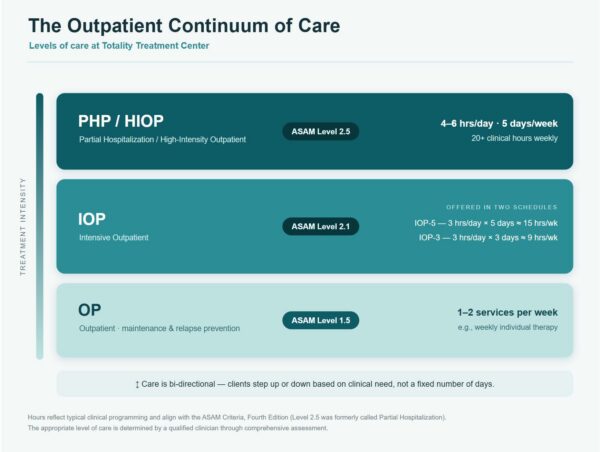
Outpatient services span a spectrum of intensity. Understanding each option helps you choose the right fit.
- Standard outpatient
- Sessions 1–2 times per week
- Ideal for mild to moderate substance use or mental health concerns
- Intensive outpatient program (IOP)
- 3–5 days per week, 3–5 hours per day
- More structure and peer support
- Often billed as iop for mental health and substance abuse
- Partial hospitalization program (PHP)
- 5–6 hours per day, 5–6 days per week
- Clinical supervision and psychiatric care
- Similar to day treatment, billed as partial hospitalization program that accepts uhc
Programs typically follow a step-down approach, reducing intensity as you demonstrate stability and growth (Golden Gate Recovery).
Compare program types
Choosing between standard outpatient, IOP and PHP can feel overwhelming. This table highlights key differences:
| Feature | Standard outpatient | IOP | PHP |
|---|---|---|---|
| Frequency | 1–2 times/week | 3–5 days/week | 5–6 days/week |
| Daily time commitment | 1–2 hours | 3–5 hours | 5–6 hours |
| Ideal for | Mild cases | Moderate to severe cases | High-acuity clients |
| Peer support | Limited | Group therapy, peer groups | Full-day group programming |
| Clinical supervision | Minimal | Moderate | Intensive, includes psychiatric care |
| Typical duration | 6–12 weeks | 6–12 weeks or longer | 2–6 months or more |
| Example internal link | — | intensive outpatient program near me | php program that accepts anthem |
Outpatient rehab may last from 4 weeks to over a year depending on severity and individual goals. Short-term programs run 2–4 weeks, standard outpatient 6–12 weeks, and extended programs 3–6 months or longer (Nirvana Recovery AZ).
Evaluate your readiness
Deciding if outpatient rehab fits your needs involves honest self-reflection and provider consultation.
Signs you might be ready
- You maintain housing and a stable routine
- You have a supportive home environment
- Your substance use has not escalated to medical emergencies
- You can commit to regular sessions and homework
- You show motivation to change and adhere to treatment recommendations (Golden Gate Recovery)
Questions to ask providers
- What intensity level do you recommend: standard outpatient, IOP or PHP?
- How long will the program last and how often will I attend?
- What family therapy or vocational training services do you offer?
- Are you licensed to treat co-occurring disorders such as depression or PTSD? If so, do you offer outpatient therapy for PTSD and addiction?
- Do you provide medication management for mental health conditions?
- What aftercare and relapse prevention support is included?
Navigate insurance and costs
Outpatient rehab can fit many budgets when you verify coverage and explore sliding-scale options.
Check your coverage
Contact your insurer to confirm benefits for outpatient behavioral health. Ask:
- Is group therapy covered under my plan?
- Do I have a deductible or copay for outpatient services?
- Are IOP and PHP programs included?
- Can I choose any in-network provider?
Popular searches include:
- outpatient therapy that accepts Cigna
- iop program that takes BCBS
- outpatient rehab that accepts Aetna
If you’re covered by Anthem, explore our php program that accepts Anthem.
Common insurance queries
- Partial hospitalization costs more than standard outpatient but less than inpatient care.
- Preauthorization may be required for IOP or PHP. Ask your provider to handle paperwork.
- Out-of-network benefits can reduce your out-of-pocket expenses if in-network options are limited.
Prepare for admission
Understanding the intake process and setting goals primes you for success.
Intake process
- Initial assessment
- Review medical, psychiatric and substance use history
- Screen for co-occurring disorders
- Treatment planning
- Develop an individualized plan with therapy, medication and support services
- Set short-term and long-term recovery goals
- Scheduling sessions
- Confirm dates and times for group and individual therapy
- Arrange family or vocational sessions if needed
Tips for success
- Arrive on time, prepared with questions and an open mind
- Keep a recovery journal to track progress and triggers
- Build a sober support network—consider outpatient support groups
- Communicate honestly with your clinician about challenges
Access ongoing support
Recovery extends beyond scheduled sessions. Complement formal treatment with continuing care.
Aftercare and relapse prevention
After completing an outpatient program, aftercare services help you transition. Look for:
- Alumni support groups
- Telephone check-ins with your treatment team
- Referrals to sober living environments, such as a sober living step down from iop program
Evidence shows that patients who remain in treatment for three months or more achieve better long-term outcomes, with higher rates of sustained abstinence (NCBI Bookshelf).
Family and peer involvement
Young adults benefit from family therapy to rebuild trust and improve communication. Peer support groups offer empathy and accountability. You might explore:
Take the next step
Choosing outpatient rehab for young adults is a courageous move toward lasting recovery. Whether you opt for standard outpatient, an IOP or a PHP, you’ll gain evidence-based therapy, peer support and practical skills to thrive.
Reach out today to verify your insurance, schedule an assessment and embark on your healing journey with confidence. Hope and healing await—you don’t have to face this alone.