Understanding IOP programs that accept Covered California
If you are looking for an IOP program that accepts Covered California, you are likely trying to balance structured treatment with the realities of work, school, or family responsibilities. Intensive outpatient programs (IOPs) provide multiple therapy sessions per week while allowing you to live at home and maintain parts of your routine.
In California, hundreds of IOPs offer addiction and mental health services at this level of care. Recovery.com evaluated 804 intensive outpatient programs across the state that deliver therapy, education, and support several times per week so clients can work on sobriety while continuing daily life commitments [1]. Knowing how Covered California plans interact with this type of treatment helps you choose care that is both clinically appropriate and financially realistic.
How Covered California works for treatment
Covered California is the state’s health insurance marketplace. You purchase a commercial plan from a private insurer, often with financial assistance, and that plan must follow federal parity rules for mental health and substance use treatment.
In practical terms, this means addiction and behavioral health services are typically covered as essential health benefits. However, coverage details vary from plan to plan. Your benefits for an IOP program that accepts Covered California depend on:
- The metal tier of your plan (Bronze, Silver, Gold, Platinum)
- Your specific carrier’s network and policies
- Whether the IOP is in network or out of network
- Medical necessity criteria that your insurer uses to approve or deny authorizations
In-network programs that contract with your Covered California plan usually have lower copays and coinsurance than out-of-network providers. This is why focusing on in-network IOP options can significantly reduce the financial burden of care.
What an IOP program typically includes
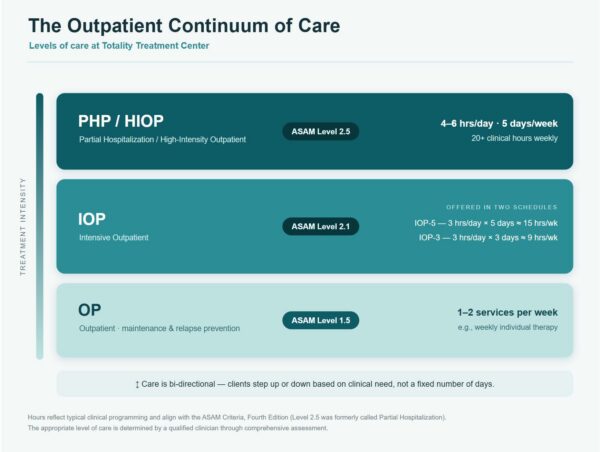
IOP is a step between standard weekly outpatient therapy and higher-intensity services like a php program that accepts covered california or residential rehab. To qualify as intensive outpatient, programs generally need to offer:
- At least 9 therapy hours per week
- Services spread across multiple days, often 3 to 5 days weekly
- A combination of group therapy, individual counseling, and psychoeducation
Across California, many IOPs use structured schedules that might include cognitive behavioral therapy, dialectical behavioral therapy, family sessions, and case management. Several programs accredited by The Joint Commission follow this model, combining evidence-based therapies, group work, and care coordination while giving you flexibility to continue work or school [1].
Some IOPs focus primarily on substance use, while others specialize in mental health conditions or dual diagnosis. There are also disorder-specific options for anxiety, depression, bipolar disorder, or PTSD. When you use Covered California, your plan can often support access to these specialized programs as long as they are in network and medically necessary.
Insurance basics for California IOPs
When you choose an IOP program that accepts Covered California, you are working within a broader insurance environment in the state. Recovery.com notes that most California intensive outpatient programs accept PPO insurance plans, while many do not work with Medicaid, Medicare, or state insurance such as Medi Cal. For instance, All In Solutions California and NoHo Recovery primarily partner with PPO plans and do not accept Medicaid or Medicare [1].
Covered California plans connect you to private PPO or HMO products. Some IOP facilities are in network with multiple marketplace carriers, while others work with specific plan types only. For example, Asana Recovery accepts PPO and HMO policies in network and can also work with carriers out of network, offering structured IOP treatment with 3 to 5 therapy sessions weekly [1]. South Coast Behavioral Health in Costa Mesa is in network with insurers such as Cigna, Aetna, and Anthem, and many clients can use their plans to cover medication management and ongoing IOP therapy, sometimes with full treatment costs paid by insurance [1].
This mix of options highlights why verifying your specific benefits and an IOP’s network contracts is so important before you start.
Covered California and levels of care
As you explore treatment, you might be deciding between detox, residential rehab, PHP, IOP, or standard outpatient care. Covered California plans can support several levels of care, but authorizations usually depend on clinical need and cost effectiveness.
You may consider:
- A detox center that accepts covered california if you need medical support to safely withdraw from alcohol, opioids, or other substances
- An alcohol rehab that accepts covered california or drug rehab that accepts covered california for structured residential care
- A php program that accepts covered california if you require full-day treatment but can safely live at home
- An IOP or outpatient program that takes covered california when you are stable enough for part-time treatment
Many insurers prefer to authorize the least restrictive level of care that still adequately addresses your symptoms. IOP often fits this category. It provides more structure than weekly therapy but less cost and disruption than inpatient or residential rehab.
If you have co-occurring mental health concerns, you might also look for dual diagnosis treatment that accepts covered california, which can include IOP tracks specifically designed to treat both conditions at once.
What IOP looks like for substance use and mental health
IOP programs that accept Covered California can focus on substance use disorders, mental health needs, or both. The structure is similar, but the clinical emphasis may differ.
For addiction-focused IOPs, you might work on:
- Managing cravings and triggers
- Building sober support systems
- Relapse prevention planning
- Repairing relationships and rebuilding daily structure
If your primary concern is mental health, an IOP can address conditions such as:
- Anxiety treatment that accepts covered california
- Depression treatment that accepts covered california
- Bipolar disorder treatment that takes covered california
- PTSD treatment that accepts covered california
In these programs, you work on symptom management, safety planning, emotional regulation skills, and functional goals like returning to work or school. For more information on broader options, you can also review mental health treatment that takes covered california and covered california mental health facilities.
In-network vs out-of-network IOP
When you are comparing IOP options, the in-network status with your Covered California plan directly affects your out-of-pocket costs. In-network programs agree to contracted rates with your insurer. This generally results in:
- Lower copays or coinsurance
- Application of charges toward your in-network deductible and out-of-pocket maximum
- Fewer surprise bills after treatment
Out-of-network programs might still be accessible, particularly if you have a PPO product or out-of-network benefits. However, you may face higher deductibles, a larger share of the overall bill, and sometimes balance billing from the provider.
Looking at covered california rehab centers and covered california detox programs that already contract with marketplace plans can be a helpful starting point if you are trying to stay in network across multiple levels of care.
What insurance typically checks before approving IOP
Most Covered California plans rely on utilization review to confirm that IOP is medically necessary for you. While specifics differ by carrier, reviewers usually consider:
- Your current symptoms and functional impairment
- Safety concerns such as suicidality, self-harm, or high-risk substance use
- Previous treatment attempts and response to lower levels of care
- Whether you can safely live at home with appropriate support
If you are stepping down from residential treatment, detox, or PHP, an IOP recommendation from your treatment team can strengthen the case for approval. The insurer may initially authorize a certain number of sessions or weeks of IOP, then review progress and request updated clinical information to extend coverage if needed.
It can help to:
- Be honest with your treatment team about symptoms and struggles
- Ensure documentation clearly reflects your needs and goals
- Ask the program how they handle prior authorizations and continued stay reviews
Many IOP providers that routinely work with Covered California plans are experienced in navigating these processes and communicating with insurers on your behalf.
Cost considerations for Covered California IOP
Even when an IOP program that accepts Covered California is in network, you still share some cost responsibility. Your exact expenses depend on:
- Deductible status for the year
- Copays or coinsurance for outpatient behavioral health services
- Whether the program bills as facility-based IOP or office-based services
- Your plan’s out-of-pocket maximum
For example, some Silver plans may require you to pay a percentage of the contracted rate per session until you meet your maximum, while Gold or Platinum plans might use fixed copays with lower overall cost sharing. Because of these variations, you should:
- Call the member services number on your insurance card
- Ask for behavioral health benefits and intensive outpatient coverage details
- Request information about your deductible, coinsurance, and out-of-pocket maximum
- Confirm whether preauthorization is required before you start IOP
You can also ask the program’s admissions or billing department to verify benefits, explain expected charges, and walk you through payment options.
Choosing between IOP and other options
If you are unsure whether IOP is the right level of care, you can compare it to alternative options covered under your plan.
You might lean toward IOP if:
- You can stay safe at home with outpatient support
- You are motivated to attend multiple sessions each week
- You need more structure than weekly therapy but do not require 24-hour supervision
You might consider higher levels of care if:
- You are at significant risk for self-harm or severe withdrawal
- You have repeatedly relapsed during outpatient or IOP care
- Your home environment is unsafe or highly triggering
In some situations, you may begin in detox, then step into residential rehab or PHP, and finally transition to IOP as your symptoms stabilize. Covered California plans can often support this continuum when care is clinically justified and you use in-network providers at each step.
If you want to review broader treatment options, you can explore covered california rehab centers for residential needs or outpatient program that takes covered california for less intensive options that might follow IOP.
How to find an IOP that accepts Covered California
To locate an IOP program that accepts Covered California and fits your needs, you can follow a simple process:
- Check your plan’s provider directory using the online member portal or app. Filter for behavioral or mental health, then for intensive outpatient services.
- Call the numbers listed for programs you are interested in and ask directly whether they are in network with your exact plan type and carrier.
- Confirm that the program treats your specific concern, whether it is addiction, a mood disorder, trauma, or a combination. If you have both mental health and substance use concerns, ask about dual diagnosis tracks.
- Ask about schedule options, such as daytime or evening IOP, to see whether the structure aligns with your work or family responsibilities.
- Request a benefits verification from each program’s admissions team so you have clear expectations about cost before starting.
If you feel overwhelmed by these steps, you can also contact your insurer’s behavioral health line and ask them to help you identify nearby in-network IOP providers. Many people use this route when they first begin exploring treatment.
When you combine clinical fit with in-network coverage, IOP can become a realistic, sustainable option instead of an overwhelming financial decision.
When IOP is part of long-term recovery
Engaging in an IOP program that accepts Covered California is often just one chapter in a broader recovery story. Many people:
- Start with detox or residential services if needed
- Continue to IOP for several weeks or months to stabilize, learn skills, and build support
- Step down to weekly outpatient therapy, support groups, or medication management
If you are working with a program that also offers covered california detox programs, residential care, and standard outpatient services, you might have a smoother transition between levels of care while staying in network the entire time.
Over the long term, your goal is to move from intensive services to sustainable supports that fit into daily life. IOP can give you the time and structure to practice new coping skills, repair relationships, and strengthen your ability to manage symptoms without the same level of clinical oversight.
By understanding how Covered California applies to IOP, and by choosing in-network programs that match your needs, you give yourself a clearer path to consistent care, fewer unexpected bills, and a treatment plan that respects both your health and your financial reality.