Understanding an outpatient program that takes Covered California
If you are looking for an outpatient program that takes Covered California, you are already taking an important step toward getting help that is both clinically appropriate and financially realistic. Covered California plans are required to include mental health and substance use disorder treatment as essential health benefits, so outpatient care is not an add-on, it is part of your core coverage [1].
Outpatient services can be a good fit if you want to keep living at home, maintain some work or school responsibilities, and still receive structured support. Your exact benefits depend on your specific plan, but understanding how coverage works will help you choose a program that fits your needs and budget.
How Covered California insurance works for treatment
Covered California is the state marketplace where you buy ACA compliant health plans. All of these plans must include a defined set of essential health benefits, which cover both medical and behavioral health care.
Essential health benefits and behavioral health
Every Covered California plan includes:
- Ambulatory patient services, which means outpatient care that does not require a hospital stay [1]
- Mental health and substance use disorder services, including counseling and psychotherapy [1]
- Rehabilitative and habilitative services that help you regain skills or function after illness, injury, or due to chronic conditions [1]
Federal law under the Affordable Care Act also requires all ACA compliant plans to cover mental and behavioral health services at the same level as other medical care [2]. California law goes a step further and requires parity in costs and timeliness for serious mental health conditions, including coverage for outpatient services, inpatient care, partial hospitalization, and prescription drugs on the same terms as physical health treatment [2].
Preventive versus ongoing treatment
It is helpful to distinguish between preventive services and ongoing treatment:
- All plans include free preventive mental health and substance use disorder services when you use in network providers and the visit is not part of ongoing treatment [3].
- Minimum coverage or catastrophic plans for people under 30 include up to three completely free outpatient or urgent care mental health visits per year with no copays or deductibles [3].
Once you move into ongoing treatment, such as an intensive outpatient program for addiction or weekly therapy for a diagnosed disorder, your plan still covers care, but deductibles, copays, or coinsurance will apply depending on your metal tier and network status [3].
Types of outpatient programs Covered California can cover
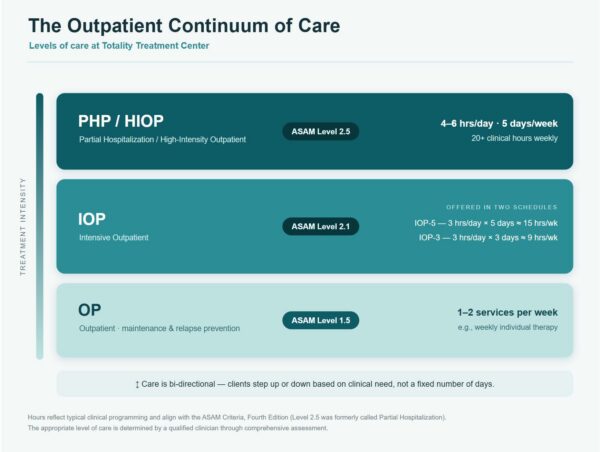
When you search for an outpatient program that takes Covered California, you will see several levels of care. These differ in intensity, time commitment, and how they fit into the broader continuum that may also include detox or residential rehab.
Standard outpatient counseling
Standard outpatient usually involves one to three sessions per week. This can be individual, group, or family therapy for issues such as:
- Anxiety, depression, or bipolar disorder
- Trauma and PTSD
- Substance use concerns that do not require daily structure
Covered California plans treat these services as part of your mental health and substance use disorder benefits, with coverage rules similar to other office visits. You can explore more on specific conditions such as anxiety treatment that accepts covered california, depression treatment that accepts covered california, and bipolar disorder treatment that takes covered california.
Intensive outpatient programs (IOP)
An intensive outpatient program, or IOP, typically involves treatment three to five days per week, often for several hours per day. You return home at night, which gives you flexibility to work part time or meet family obligations.
IOPs are commonly used for:
- Substance use disorders when 24/7 supervision is not required
- Step down care after residential rehab or partial hospitalization
- Moderate to severe mental health conditions that need more support than weekly therapy
Outpatient rehab, including IOP, usually costs less than inpatient care because there are no overnight stays and fewer treatment hours overall, which makes it more financially accessible when you are using insurance [4]. Many California treatment centers accept PPO plans, while Medicaid, Medicare, and some HMOs may be less commonly accepted at certain facilities [4].
If you are specifically comparing higher intensity options, you can also look at an iop program that accepts covered california.
Partial hospitalization programs (PHP) and high intensity outpatient
Partial hospitalization programs, sometimes called high intensity outpatient or day programs, provide several hours of care most days of the week. You spend the day in treatment and go home at night.
California law includes partial hospitalization as a required benefit for serious mental health conditions, covered on the same terms as other medical services [2]. When these programs are in network, your out of pocket costs are significantly lower than if you choose an out of network option.
If you need this level of care, exploring a php program that accepts covered california can help you identify programs where your benefits will apply.
Disorder specific and dual diagnosis outpatient care
Many people need help for both mental health and substance use at the same time. Covered California plans must cover diagnosis and treatment for serious mental health conditions, and federal law requires coverage for substance use disorder care as well [3].
You may benefit from:
- dual diagnosis treatment that accepts covered california if you have co occurring mental health and substance use disorders
- ptsd treatment that accepts covered california if trauma is a major driver of your symptoms
- Condition specific mental health programs at depression treatment that accepts covered california
These programs often operate at outpatient, IOP, or PHP levels, depending on the severity of symptoms and safety needs.
Why in network outpatient programs are more affordable
When you focus on an outpatient program that takes Covered California and is in network with your specific plan, you significantly reduce financial barriers.
Contracted rates and lower member costs
In network providers have contracts with your insurance company. These agreements:
- Lock in lower negotiated rates for services
- Allow your copays and coinsurance to apply at the lower in network level
- Ensure that payments count toward your in network deductible and out of pocket maximum
Out of network programs can bill higher rates, and your plan may cover a smaller percentage of the bill or nothing at all, depending on your policy.
Outpatient rehab programs in California typically cost between 1,000 and 10,000 dollars for a 90 day program, with IOPs that meet several times a week at the higher end of that range [5]. Using in network benefits through Covered California can absorb a large portion of that cost.
Parity protections and appointment access
California law requires that health plans provide access to return behavioral health appointments within 10 business days after referral or an initial visit [3]. The same law mandates parity for serious mental health conditions, which means your plan cannot impose stricter limits on mental health services than on other types of medical treatment [3].
These protections apply to in network providers, so choosing an in network outpatient program increases your chances of getting timely, covered care without extra barriers.
Coverage criteria for addiction and mental health outpatient care
Your plan will generally apply the same core rules to mental health and substance use disorder services as it does to other medical care, but there are some behavioral health specifics to be aware of.
Medical necessity and level of care
To authorize an outpatient program, your plan will look for evidence that:
- You have a diagnosable mental health or substance use disorder
- The requested level of care, such as IOP or PHP, is medically necessary and appropriate
- A lower level of care, such as standard outpatient, would not be sufficient right now
Under the Affordable Care Act, outpatient addiction treatment programs are required to be covered similarly to other medical services, which supports access for Californians who meet medical necessity criteria [4]. Treatment centers and your insurer typically coordinate to document this need.
Prior authorization and ongoing review
Some plans require prior authorization before you start an IOP or PHP. Others may allow an initial assessment or a limited number of sessions before authorization is needed. Once you are in treatment, your provider may submit periodic updates to continue coverage.
For outpatient therapy at a standard level, prior authorization is less common, particularly for preventive or early stage care. All plans offered through Covered California include free preventive mental health and substance use disorder services when you use in network providers and the service is not part of ongoing treatment [3].
Finding an outpatient program that takes Covered California
Knowing how coverage works is one piece of the puzzle. The next step is finding a specific program that is both clinically appropriate and in network with your plan.
Use Covered California and plan tools
Covered California provides tools and customer support to help you:
- Identify plans that include behavioral health benefits
- Find providers and facilities that are in network for your specific coverage [2]
In addition, most insurance carriers have online directories where you can search for:
- Outpatient clinics
- IOP or PHP programs
- covered california mental health facilities and covered california rehab centers
If you prefer a more guided approach, Covered California’s customer service can help you navigate options and clarify which programs are considered in network.
Contact treatment centers directly
Treatment centers that work regularly with marketplace plans are often familiar with Covered California policies. Many offer:
- Free addiction or mental health assessments
- Insurance verification to confirm your benefits before you start care
For example, some rehab providers in California accept most major insurance plans, including coverage through Covered California, and provide free insurance checks to help you understand your outpatient benefits [5]. This can clarify what you would pay for an outpatient program, IOP, or PHP.
Patients seeking outpatient programs covered by Covered California are encouraged to verify their insurance benefits directly with treatment admissions teams, since in network status and coverage details vary widely between programs [4].
Use confidential locator tools for mental health
If you are looking specifically for outpatient mental health programs, you can use the Behavioral Health Treatment Services Locator, which is a confidential resource to find services that may accept Covered California insurance [2]. This can be a first step if you are unsure where to begin or want to compare multiple programs.
If you already know you need higher levels of care such as detox or residential treatment, you can also explore a detox center that accepts covered california, covered california detox programs, or a drug rehab that accepts covered california before stepping down into outpatient care.
Typical costs for Covered California outpatient programs
Your individual out of pocket cost depends on the plan metal tier, your deductible status, and whether the program is in network.
General cost ranges and how insurance helps
In California, outpatient rehab programs typically range from about 1,000 to 10,000 dollars for a 90 day episode of care, with more intensive IOPs toward the higher end of that spectrum [5]. When you use a Covered California plan:
- The plan pays a share of the contracted rate once you meet your deductible
- You pay a copay or coinsurance for each session or week of program
- Your spending counts toward the annual out of pocket maximum
Because outpatient programs have fewer hours and no overnight lodging, they usually cost less than residential or inpatient treatment, which makes them more accessible for many insured patients [4].
What varies by metal tier
Bronze, Silver, Gold, and Platinum plans all cover the same essential health benefits, but they distribute costs differently:
- Bronze may have lower premiums but higher deductibles and coinsurance for outpatient services
- Silver often provides a balance between premium and out of pocket costs
- Gold and Platinum typically have higher premiums but lower copays and deductibles for each visit or program day
Non preventive mental health services, such as ongoing therapy or outpatient rehab, fall under these cost sharing rules, so your exact payment will follow your plan’s benefit design [3].
When outpatient is part of a larger treatment plan
Sometimes outpatient care is the first level of support. In other situations it is part of a stepped approach that includes detox or residential treatment.
Transitioning from detox or inpatient to outpatient
If you have been using alcohol or drugs heavily, you may need medically supervised detox before starting an outpatient program. All Covered California plans include ambulatory patient services and mental health and substance use disorder coverage, which extends to detox and other early stage care when medically necessary [1].
After detox, you might move into:
- Residential rehab, then step down to PHP, IOP, and finally standard outpatient
- Directly into IOP or PHP if residential care is not required
You can learn more about aligning detox and rehab with your benefits through resources like covered california detox programs, alcohol rehab that accepts covered california, and covered california rehab centers.
Coordinating mental health and addiction care
If you have co occurring conditions, your outpatient plan should address both at the same time. Covered California plans must cover diagnosis and treatment for serious mental health conditions such as major depressive disorder and bipolar disorder, with costs and timeliness on par with other medical care [3].
You might use:
- A mental health treatment that takes covered california provider for therapy and medication management
- A dual diagnosis treatment that accepts covered california program that integrates addiction and mental health services in one setting
When these services are coordinated, you have a better chance of stabilizing both symptom sets and maintaining gains once you finish the more intensive phases of treatment.
Next steps to start an affordable outpatient program
If you are ready to move forward with an outpatient program that takes Covered California, you can:
- Locate your insurance card and log in to your health plan portal to review behavioral health benefits and confirm your deductible and copay amounts.
- Use your plan’s provider directory or Covered California’s tools to identify in network outpatient, IOP, or PHP programs that match your needs.
- Call one or two programs to ask about level of care, specialization, schedules, and whether they verify coverage and provide cost estimates.
- Schedule an intake assessment, which often includes a diagnostic evaluation that your plan will use to confirm medical necessity.
- If you are not sure where to start, look for programs listed under covered california mental health facilities or covered california rehab centers and ask directly about outpatient options.
Your Covered California insurance is designed to support you in getting help for mental health and substance use issues, not to stand in the way. When you combine that coverage with an in network outpatient program that fits your situation, you make treatment more affordable and more sustainable, so you can focus on recovery rather than worrying about every bill.