The first 90 days after leaving an intensive outpatient program are statistically the most dangerous stretch of recovery. Knowing how to prevent relapse after leaving IOP isn’t about motivation or willpower , it’s about building a specific structure to replace the one that just ended.
What You’ll Need Before You Start
Before applying any of these strategies, have three things in place. First, you should be at or near the end of your IOP, not weeks out from discharge , the earlier you start building the post-treatment plan, the more leverage it gives you. Second, identify a named treatment provider or therapist who will handle your step-down care. A vague plan (“I’ll find someone”) is not a plan. Third, have at least a preliminary understanding of your personal triggers, even if it’s incomplete. This guide will help you sharpen that picture, but you need a starting point.
The process described here is active, not passive. Recovery after IOP doesn’t happen by default.
Step 1: Understand Why the First 90 Days After IOP Are the Highest-Risk Window
The risk is highest when the structure disappears. That’s not a metaphor , it’s a measurable pattern in the research, and understanding it changes how you approach the transition.
What the Research Says About Early Relapse Timing
A 2020 study published in the Journal of Substance Abuse Treatment tracked 1,226 adults following discharge from structured outpatient treatment. Relapse rates were highest in the first 30 to 90 days post-discharge, with the peak occurring in weeks two through six , after the initial post-treatment vigilance fades but before new habits have consolidated.
What this means in practice: the schedule that protected you in IOP disappears overnight. Group sessions, therapist check-ins, peer contact, and structured afternoons all vanish simultaneously. Your brain is still in the process of rewiring, and it’s doing so without the scaffolding it depended on.
The Momentum Gap: Why Structure Does the Heavy Lifting
IOP provides something that feels invisible until it’s gone: external accountability. Every session gave you a reason to show up sober, a group of people who noticed if you didn’t, and a schedule that occupied the hours when cravings tend to peak. Remove all three at once, and the first week post-discharge becomes a vulnerability spike , not because you’ve gotten weaker, but because the structure was doing more work than you realized.
Call this the momentum gap. The first seven days after discharge are the window where the gap is widest. Closing it is the goal of every step that follows.
Step 2: Build a Step-Down Care Plan Before Your Last IOP Session
Continuity of care is the evidence-backed mechanism for sustained recovery. Willpower is not. A 2017 meta-analysis in Addiction Science and Clinical Practice reviewed 27 studies and found that patients who transitioned directly into continued outpatient care were significantly less likely to relapse within 90 days than those who exited treatment entirely , regardless of the substance involved.
The step-down plan gets built before discharge, not after. Aftercare planning that begins on day one of treatment, rather than in the final week, produces meaningfully better outcomes because the plan has time to be stress-tested and adjusted.
How to Choose the Right Level of Step-Down Care
The decision depends on four factors: the frequency and intensity of cravings you’re still experiencing, whether you carry a co-occurring mental health diagnosis, the stability of your home environment, and your work or school obligations. A professional with a demanding schedule and a supportive household has different step-down needs than a college student living in a shared apartment with limited structure.
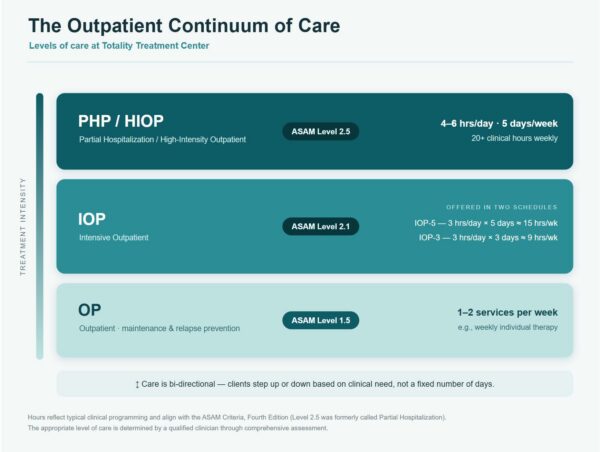
Standard options include partial hospitalization (PHP), standard weekly outpatient therapy, individual therapy with a licensed counselor, and medication-assisted treatment where applicable. The right answer is the one that creates consistent contact with a clinical provider without creating a schedule you’ll abandon in week three.
What to Ask Your Treatment Team at Discharge
Bring three specific questions to your final IOP session. First: what frequency of contact do you recommend for my specific profile? Second: if I experience a crisis in the first 30 days, who do I call and what is the actual protocol? Third: if I’m on any prescribed medications, who manages continuity of those prescriptions during the transition?
These are the three highest-leverage questions in the entire transition period. The answers determine whether your aftercare plan has real edges or just intentions.
Step 3: Activate Your Support Network With a Specific Ask
Vague support has a measurably lower impact than named, scheduled accountability. A 2016 study from the American Journal of Drug and Alcohol Abuse examined 412 adults in early recovery and found that the quality of social support , defined as specificity and reliability of contact , predicted 12-month outcomes far better than the size of the support network.
The move here is converting passive support into structured contact.
How to Structure an Accountability Check-In
An effective check-in has three components: a named person, a specific day and time, and a short agenda. The agenda follows a simple sequence: one win since the last check-in, one current challenge, and one specific need. This is proactive contact, not a crisis call. The distinction matters because it builds the habit of reaching out before things escalate, not after.
Schedule the first check-in before discharge. Don’t wait until you feel like you need it.
How to Talk to Family Members Who Don’t Understand Recovery
Not every family comes into the post-IOP period with recovery literacy. Many clients in California come from households where addiction was either minimized or stigmatized, and where “support” looks more like surveillance or enabling than genuine connection. Research on family involvement in recovery, including a 2019 study in Family Process, shows that structured family communication improves outcomes , but only when the family understands their specific role.
The script is simple: tell the family member what you need, not what addiction is. “I need you to check in with me every Thursday at 7pm and ask how the week went” is more useful than a conversation about the neuroscience of dependence. For rebuilding those relationships on a stronger foundation, working through communication and trust explicitly is a separate and worthwhile process.
Step 4: Map Your Triggers Before They Find You
Trigger identification is a proactive practice. The HALT model , Hungry, Angry, Lonely, Tired , is the most tested entry-level framework for this, and research supports its utility: a 2015 study in the Journal of Addictive Behaviors found that negative physical and emotional states accounted for 38% of relapse events in a sample of 843 adults in early recovery.
The goal of this step is a written trigger map completed in the first week post-discharge.
High-Risk Situations to Identify in Week One
Work through four categories and answer each as a specific question about your own life, not a generic checklist. Under stress: what specific work, financial, or relational situations have historically preceded cravings? Under environment: are there physical locations, times of day, or sensory cues that activate craving pathways? Under social settings: which social configurations , specific people, events, or sizes of groups , increase your risk? Under overconfidence: when have you previously felt “past it” and what did that feeling precede?
A 2020 study in Drug and Alcohol Dependence found that environmental cue reactivity is strongest in familiar settings , meaning the home environment, not the bar, is often the highest-risk location in early post-treatment recovery.
How to Build a 72-Hour Early Warning Protocol
Most relapses follow a three-stage sequence: an emotional shift (irritability, numbness, or low-grade anxiety), followed by a behavioral change (withdrawal, sleep disruption, skipping check-ins), followed by craving escalation. Assign a specific action to each stage. For stage one, the action is naming the shift to your accountability contact. For stage two, the action is calling your therapist or treatment provider. For stage three, the action is activating your crisis protocol , the one you clarified at discharge.
This is the trigger map converted into a decision tree.
Step 5: Replace IOP Structure With a Daily Recovery Anchor
A 2012 study in PLOS ONE tracked habit formation across 96 participants over 12 weeks and found that daily repetition of a single behavior in a consistent context reduced the cognitive load of that behavior by 40% within 66 days on average. The implication for recovery: structure doesn’t have to be rebuilt all at once. One consistent daily anchor creates the neurological foothold everything else attaches to.
How to Choose an Anchor That Fits Your Real Life
The anchor has to fit the actual life, not an ideal version of it. For a working professional, a morning call to a sponsor or peer before the workday begins is realistic and repeatable. For a college student, a campus recovery meeting two evenings per week creates both structure and community. For a single parent, a ten-minute journaling practice after the kids are in bed is achievable without adding logistical complexity.
The specifics matter less than the consistency. Pick one, put it in the calendar, and protect it for 30 days before adding anything else. Rebuilding daily structure and identity after treatment is a longer process, but the anchor is where it starts.
Step 6: Use Relapse Prevention Apps and Digital Tools Strategically
A 2021 review in JMIR mHealth and uHealth analyzed 18 studies on app-assisted recovery support and found that apps improved self-monitoring and reduced perceived isolation , with the strongest effects for users who also maintained human clinical contact. Apps work as a support layer, not a replacement for it.
WEconnect Health offers daily check-ins and accountability reminders integrated with a peer support network. Sober Grid provides community connection and a real-time “Burning Desire” button that connects users to support during high-risk moments. Both are tools for low-intensity daily maintenance.
When to Use an App and When to Call a Person
The distinction is straightforward: apps are for daily tracking, logging, and low-grade check-ins. A phone call to a real person is the right response when warning signs escalate past stage one of the 72-hour protocol. The risk to watch for is using digital tools as avoidance , scrolling a recovery forum instead of calling the therapist. If engagement with an app is replacing human contact, it’s become a liability.
Step 7: Know Exactly What to Do If You Slip
A slip is a medical event with a defined response protocol. The abstinence violation effect, documented extensively since Marlatt and Gordon’s foundational 1985 research and replicated in multiple subsequent studies, shows that the cognitive and emotional response to a slip , specifically, catastrophizing it as proof of failure , predicts continued use more reliably than the slip itself. The response is the variable.
Your Three-Step Response to a Slip
First, stop the behavior immediately. Second, contact a named person from your support network within the hour. Not “soon” , within the hour, because the research on the abstinence violation effect shows the cognitive spiral accelerates quickly. Third, call your treatment provider the same day to discuss re-engagement with clinical support. These three steps, in this order, within this timeframe, interrupt the pattern before it compounds.
Troubleshooting: Common Obstacles in the First 60 Days
The most common failure points in the post-IOP period are not character flaws. They’re predictable, and each has a corrective action.
When Motivation Drops After the First Few Weeks
The post-IOP motivation dip typically appears around weeks three to five, after the initial post-discharge energy fades and before new habits feel automatic. This is neurologically driven , dopamine regulation is still stabilizing. The corrective move is behavioral activation, not motivational self-talk. Pick one scheduled activity from your recovery plan and complete it regardless of how you feel. Behavior precedes motivation at this stage, not the other way around.
When Family Support Causes Friction Instead of Helping
Not every home environment is recovery-supportive, and pretending otherwise creates risk. If family dynamics are a destabilizing factor rather than an asset , due to enabling behavior, conflict, or limited understanding of recovery , the alternative anchors are Al-Anon for family members, family therapy as an add-on to individual care, and peer-based community through recovery groups. The goal is not to fix the family system in the first 60 days. The goal is to build enough external support that the home environment isn’t the only anchor.
For clients navigating re-entry into work or professional life during this period, managing that transition without destabilizing recovery is a practical challenge that deserves direct planning.
What to Do This Week
Schedule the first step-down care appointment before the final IOP session ends. If scheduling wasn’t possible before discharge, the window is 48 hours post-discharge , not the following week, not when things settle. The research on care continuity is consistent: the gap between structured treatment and the next clinical contact is the single most predictive variable in 90-day outcomes. Every other strategy in this guide builds on that foundation. This is the one move that makes the rest of it work.